Russian altar cross in bronze | C. 1900
High-resolution photographs are available on request. Images shown on this website may have been edited for presentation purposes. For a definitive assessment of the object, please contact us to request unedited original photographs.
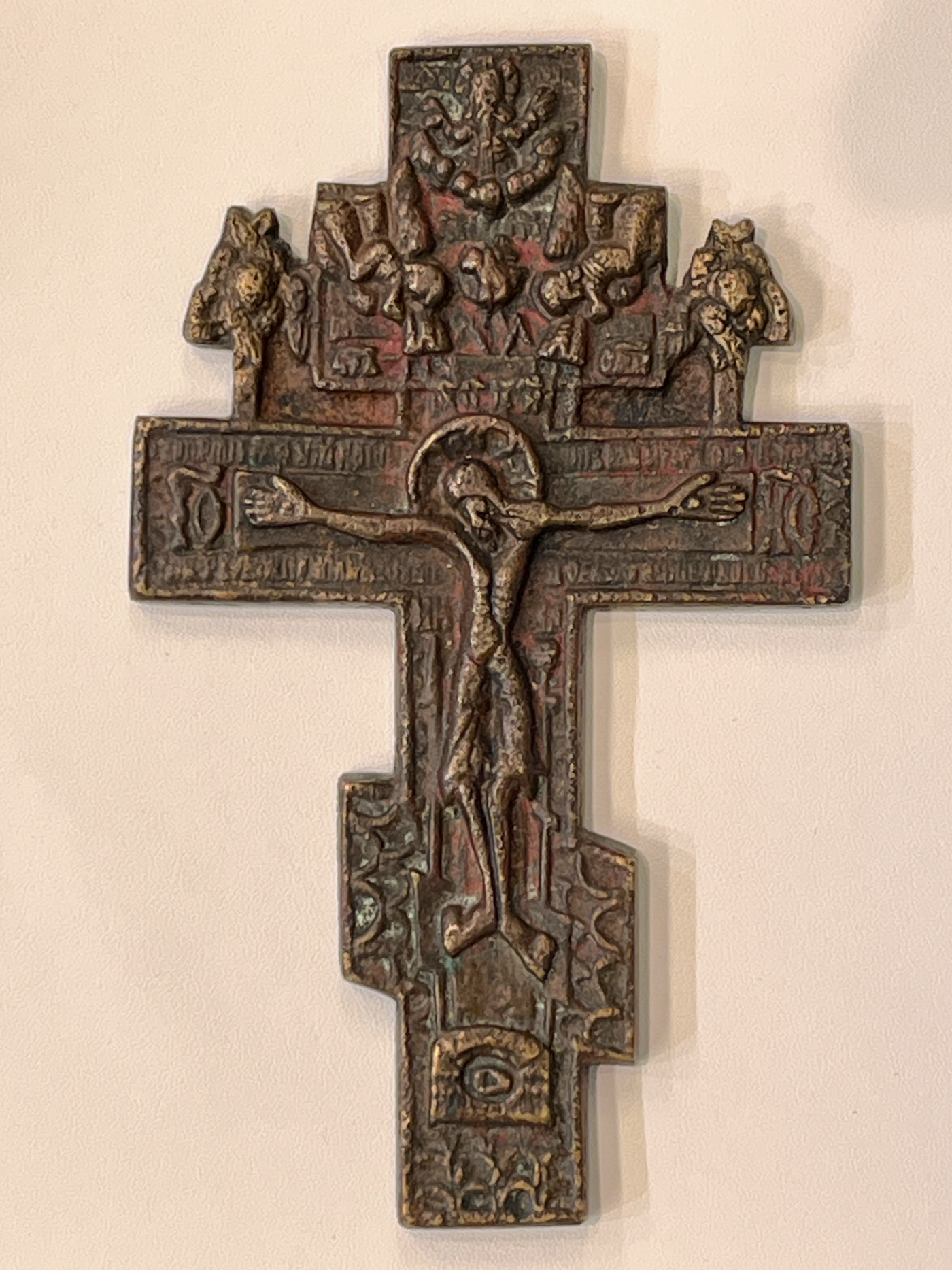
Russian altar cross in copper, brass, and bronze alloy, dating to around 1900. This richly detailed Orthodox cross unites the Crucifixion, Resurrection, and the entire history of salvation within a compact and deeply symbolic composition.
Bronze cross from around 1900, 15 × 9 cm.
This Russian metal cross dating to around 1900 represents one of the classic forms of Orthodox devotional and altar crosses. Crafted from an alloy of copper, brass, and bronze, it combines fine craftsmanship with an extraordinary richness of theological symbolism. Unlike many Western crucifixes, Orthodox tradition does not focus exclusively on Christ’s suffering but understands the Cross simultaneously as the sign of victory over death and corruption.
The entire iconographic program of this cross therefore points not only to the Crucifixion but also to the Resurrection and the redemption of humanity. At the center appears Christ upon the Cross. On either side are depicted the instruments of the Passion. To the left stands the Holy Lance that pierced Christ’s side, while to the right appears the reed bearing the sponge soaked with vinegar. Above Christ are represented the sun and moon.
These elements symbolize not only the darkening of creation during the Crucifixion but also the cosmic significance of Christ’s sacrifice. The Cross thus becomes the center of the entire created order. Beneath it appears the skull of Adam. According to ancient Christian tradition, Christ was crucified at the place where Adam had been buried. The blood of Christ symbolically descends upon the remains of the first man, bringing redemption to all humanity and reversing the consequences of the Fall.
Particularly distinctive is the form of the Orthodox Cross with its three crossbeams. The upper short beam represents the inscription placed above Christ during the Crucifixion. The central beam supports His outstretched arms. The lower diagonal beam symbolizes the footrest of the Cross. Its slant carries profound spiritual meaning: the upward side points toward the repentant thief who entered Paradise, while the downward side recalls the unrepentant thief who rejected salvation.
In the upper section appear God the Father, the Holy Spirit in the form of a dove, angels, and cherubim. Through these elements, the Cross is revealed not as a sign of defeat but as a manifestation of the Holy Trinity and the divine plan of salvation. The inscription, “We venerate Thy Cross, O Master, and glorify Thy holy Resurrection,” summarizes the central message of Orthodox Christianity: Cross and Resurrection are inseparable realities.
Rich in symbolism and powerful in design, this cross stands as an outstanding example of Russian metalwork and Orthodox devotion at the turn of the twentieth century.
Object identity
- Object title
- Bronze cross
- Inventory number
- 25004
- Origin or type
- Bronze Icons
- Date
- Around 1900 / Modern
- Dimensions
- 15 × 9 cm
- Canonical page
- https://ikonen-mautner.com/en/collection/bronzekreuz-25004
Learn about object identification and certificate verification
Sold — this archive record stays online for art-historical reference.