Bronze cross | Bronzekreuze, 17th Century
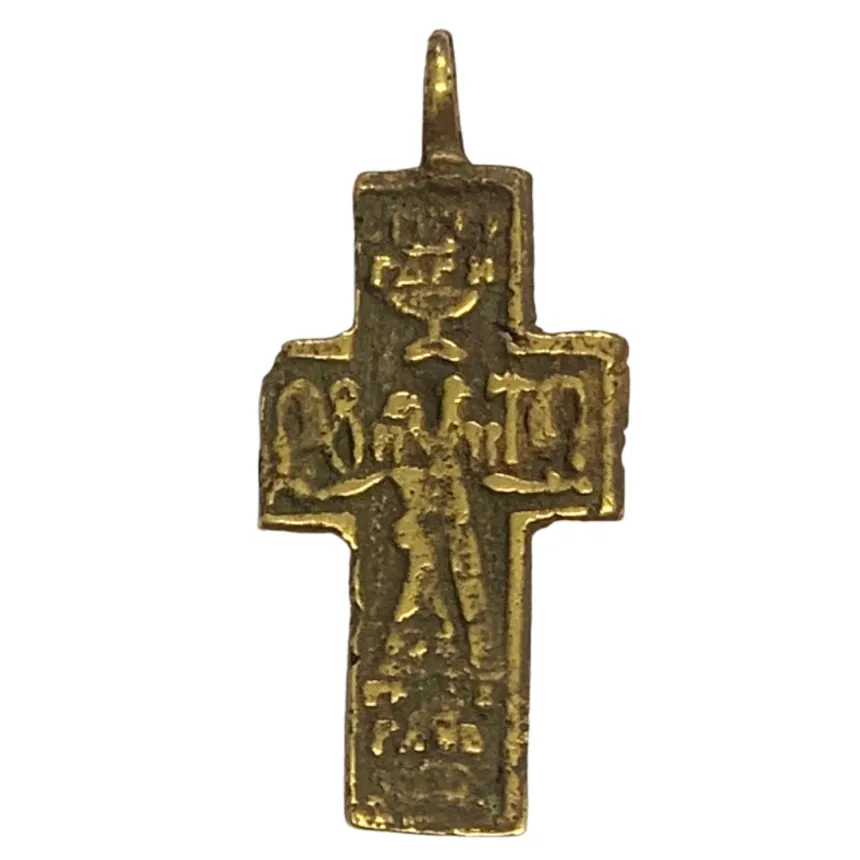
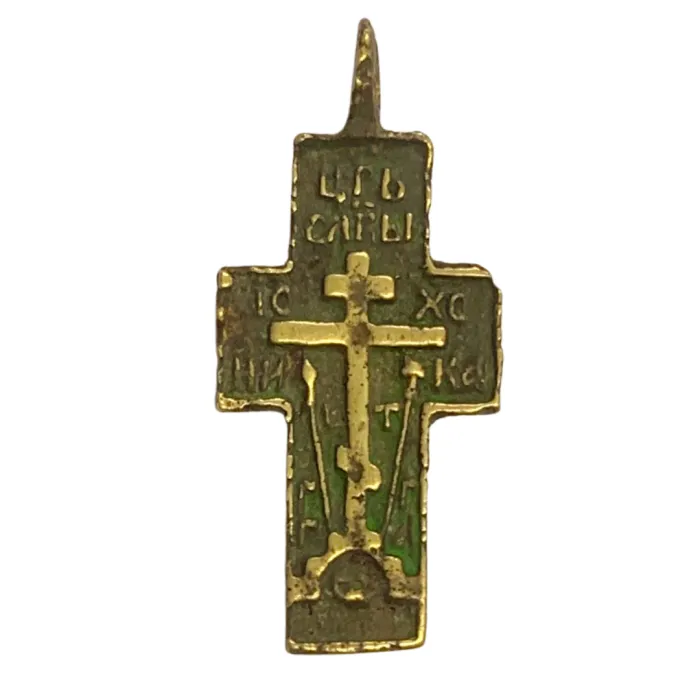
High-resolution photographs are available on request. Images shown on this website may have been edited for presentation purposes. For a definitive assessment of the object, please contact us to request unedited original photographs.
Price on request
Rare 17th-century Russian Orthodox baptismal cross cast in bronze depicting the Crucifixion on Golgotha and the Instruments of the Passion on the reverse. This small devotional object combines personal piety, spiritual protection, and the profound tradition of Orthodox cross veneration.
Bronze cross from the 17th century, 4.8 × 2.2 cm.
This 17th-century Russian Orthodox baptismal cross belongs to the early portable devotional objects of the Orthodox world and was most likely originally worn as a personal protective and blessing cross. Cast in bronze, brass, or copper-based yellow metal, the front displays the characteristic Orthodox cross form with three horizontal bars. At the center appears the Cross of Christ on Golgotha, flanked by the spear and hyssop staff — traditional instruments of the Passion.
The surviving Church Slavonic inscription may be translated as: “King of Glory, Jesus Christ, triumphs,” reflecting the Orthodox understanding of the Cross not merely as an instrument of suffering but as the victorious sign of salvation over death and sin. The distinctive structure of the Orthodox cross carries profound symbolic meaning within Eastern Christianity. The upper crossbar refers to the titulus bearing the inscription INRI (“Jesus of Nazareth, King of the Jews”), while the central beam represents the actual crucifixion bar.
The lower slanted beam symbolizes the suppedaneum, or footrest of Christ, and is additionally interpreted as a sign of divine judgment and redemption. Beneath the Cross appears Golgotha represented as a stylized hill, reinforcing the salvific significance of the Crucifixion. Particularly remarkable is the reverse side featuring the Arma Christi, or Instruments of the Passion.
Within Orthodox devotion, such imagery served not only as a reminder of Christ’s suffering but also as an apotropaic symbol believed to protect against illness, misfortune, and evil forces. Small baptismal and protective crosses of this kind were widespread throughout 17th-century Russia and were worn by both children and adults. The visible patina and traces of use give the object an authentic historical presence and make it an important testimony to early modern Russian Orthodox folk devotion.
Object identity
- Object title
- Bronze cross
- Inventory number
- 24865
- Origin or type
- Bronze Icons
- Date
- 17th Century
- Dimensions
- 4.8 × 2.2 cm
- Canonical page
- https://ikonen-mautner.com/en/collection/bronzekreuz-klein-24865
Learn about object identification and certificate verification