Dormition of the Mother of God | Metal oklad, c. 1900
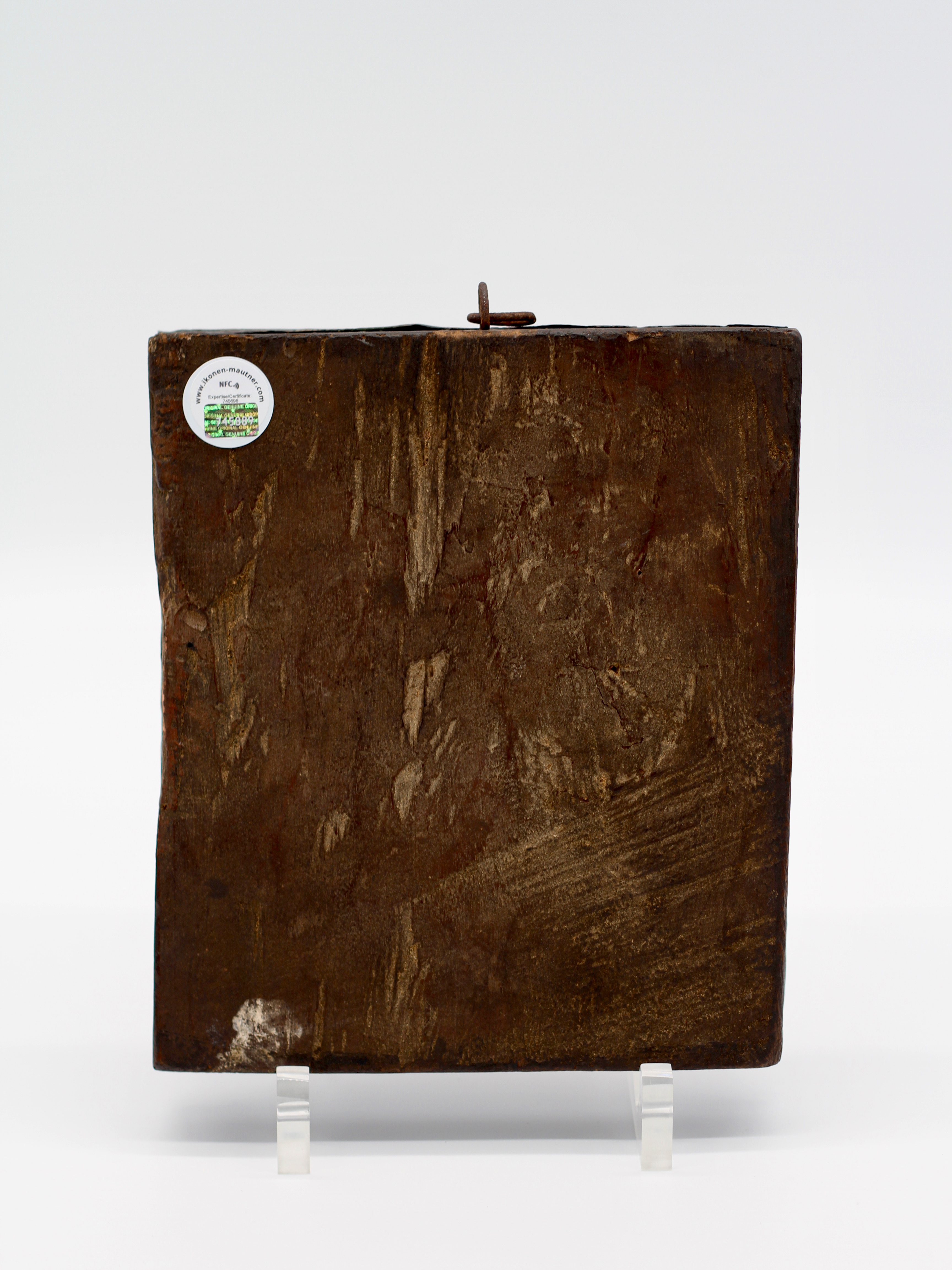
High-resolution photographs are available on request. Images shown on this website may have been edited for presentation purposes. For a definitive assessment of the object, please contact us to request unedited original photographs.
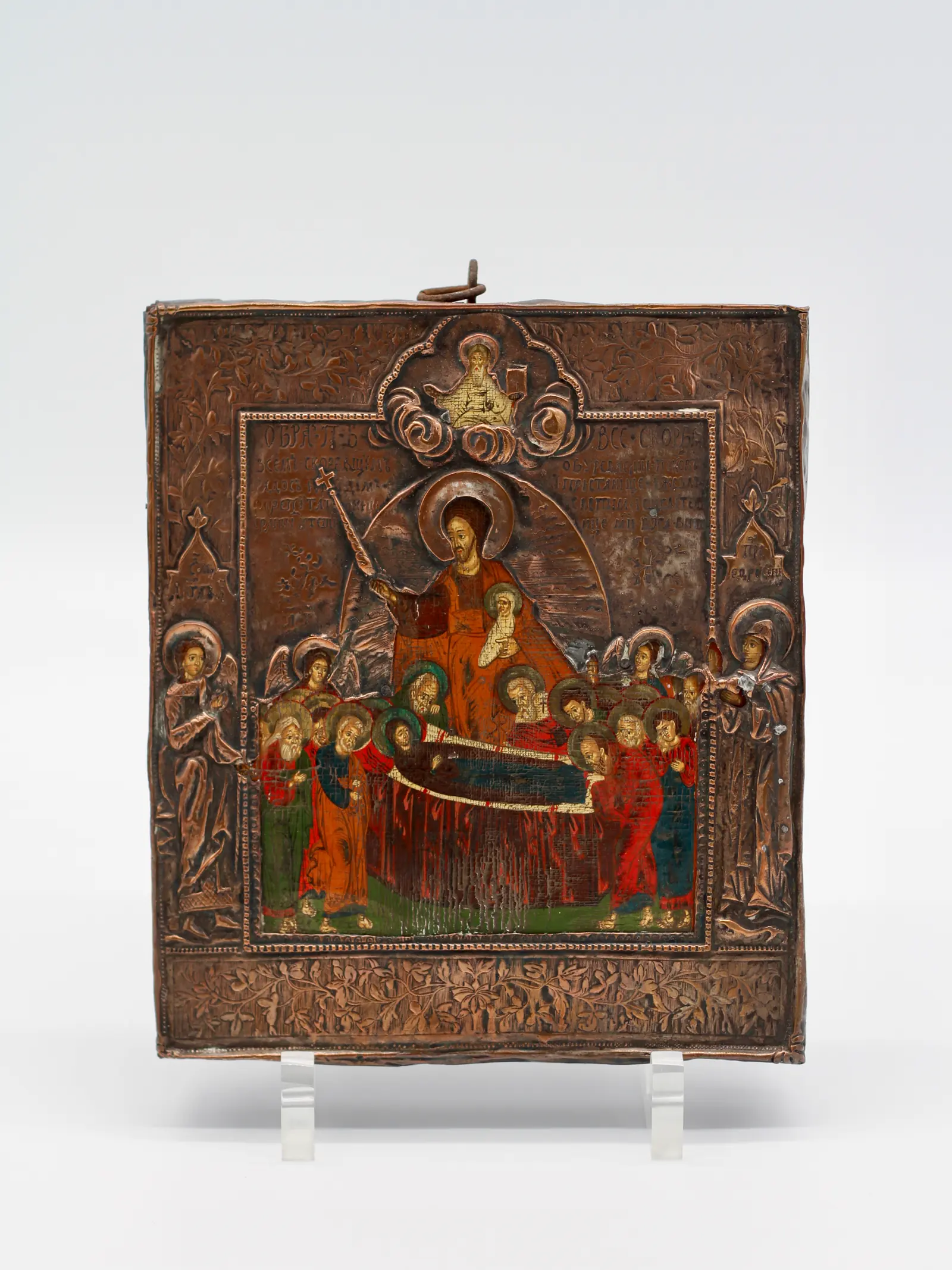
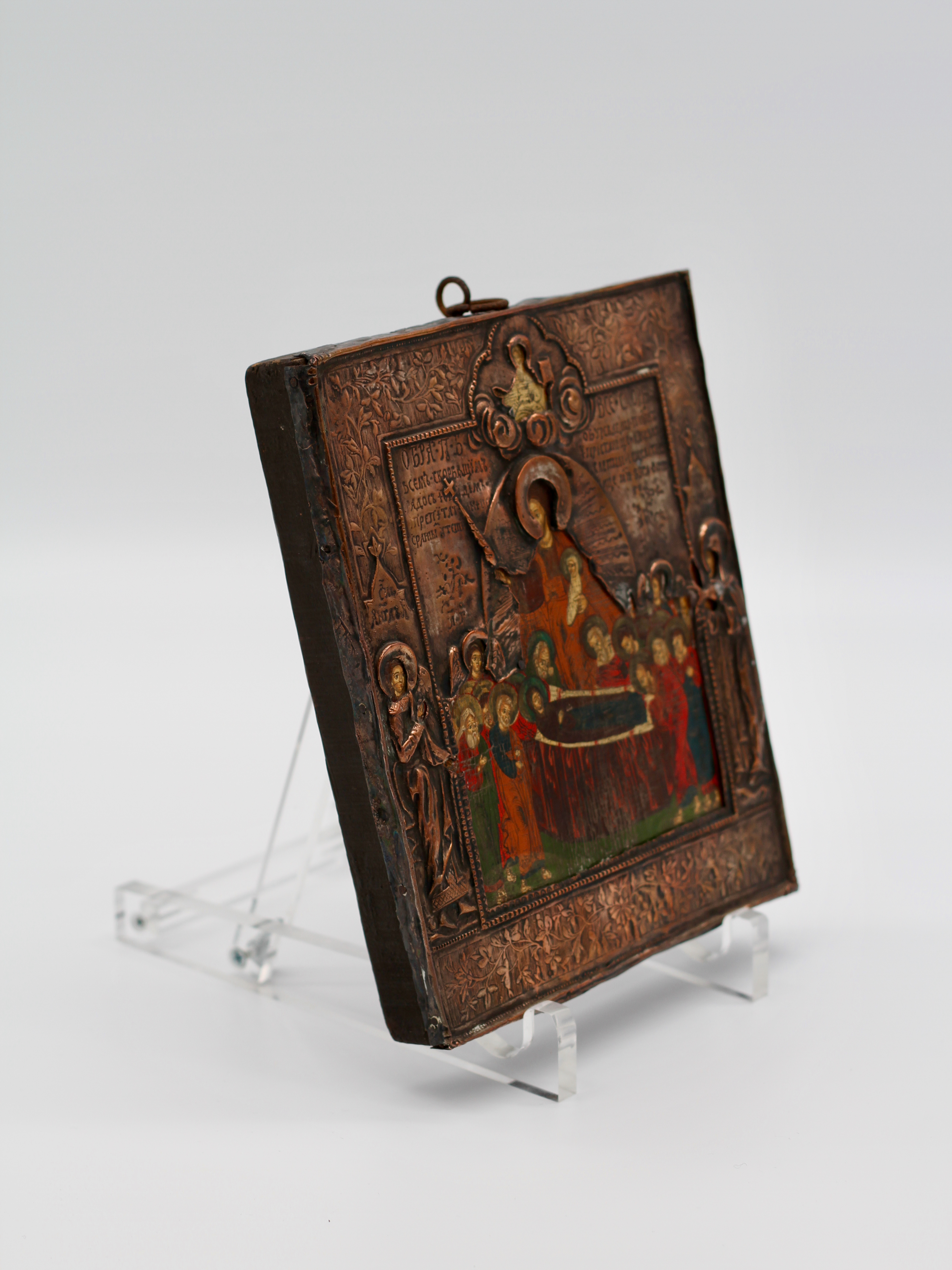
Russian icon of the Dormition of the Mother of God, created around 1900, featuring uncommon border saints and a reused metal oklad. This theologically rich composition combines the hope of resurrection with devotion to the Mother of God as heavenly intercessor and queen. Of particular interest is the reused metal oklad, whose openings were not originally designed for the present composition.
Russian icon from around 1900, 22.5 × 19.5 cm, with a metal oklad.
This Russian Orthodox icon, created around 1900, depicts the Dormition of the Mother of God, one of the most important Marian feasts of the Orthodox Church. Also known by its Greek name “Koimesis,” the subject has been among the central themes of Orthodox iconography for centuries. At the center lies the Mother of God upon her bier, surrounded by the Apostles who, according to Church tradition, were miraculously gathered from across the world to be present at her passing.
Above her appears Christ within a radiant red mandorla, holding the soul of His Mother in the form of a white-clad child. This powerful image expresses the Orthodox belief that Mary was received into heavenly glory by Christ Himself after her earthly death. Particularly noteworthy is the figure of Jechoniak before the bier of the Virgin. According to tradition, he attempted to disrupt the funeral procession and overturn the bier.
An angel carrying a drawn sword intervened and severed his hands, emphasizing both the sanctity of the Mother of God and the divine protection surrounding her body. Among the principal figures are the Apostles Peter, Paul, and John the Theologian, who traditionally participate in the Dormition scene. Above the composition appears God the Father bestowing His blessing, adding a further heavenly dimension to the icon. The icon gains a distinctive personal character through its marginal saints.
Alongside a Guardian Angel appears Saint Euphrosyne of Alexandria, one of the most remarkable figures of early Christian hagiography. According to tradition, she lived for nearly forty years disguised as a monk under the name Smaragdus in a men’s monastery before her true identity was revealed shortly before her death. The icon also features a particularly interesting metal oklad that was originally created for an icon of the Mother of God “Joy of All Who Sorrow” and was later adapted to this composition.
The combination of profound theological symbolism, personal devotional elements, and a historically layered appearance makes this work a fascinating example of Russian sacred art from around 1900.
Object identity
- Object title
- Dormition of the Mother of God
- Inventory number
- 24992
- Origin or type
- Icons with Metal Oklad
- Date
- Around 1900 / Modern
- Dimensions
- 22.5 × 19.5 cm
- Oklad
- Metal Oklad
- Canonical page
- https://ikonen-mautner.com/en/collection/entschlafen-der-gottesmutter-metalloklad-24992
Learn about object identification and certificate verification
Sold — this archive record stays online for art-historical reference.