Nativity with the Magi | Icon c. 1800, 31 × 26 cm
High-resolution photographs are available on request. Images shown on this website may have been edited for presentation purposes. For a definitive assessment of the object, please contact us to request unedited original photographs.
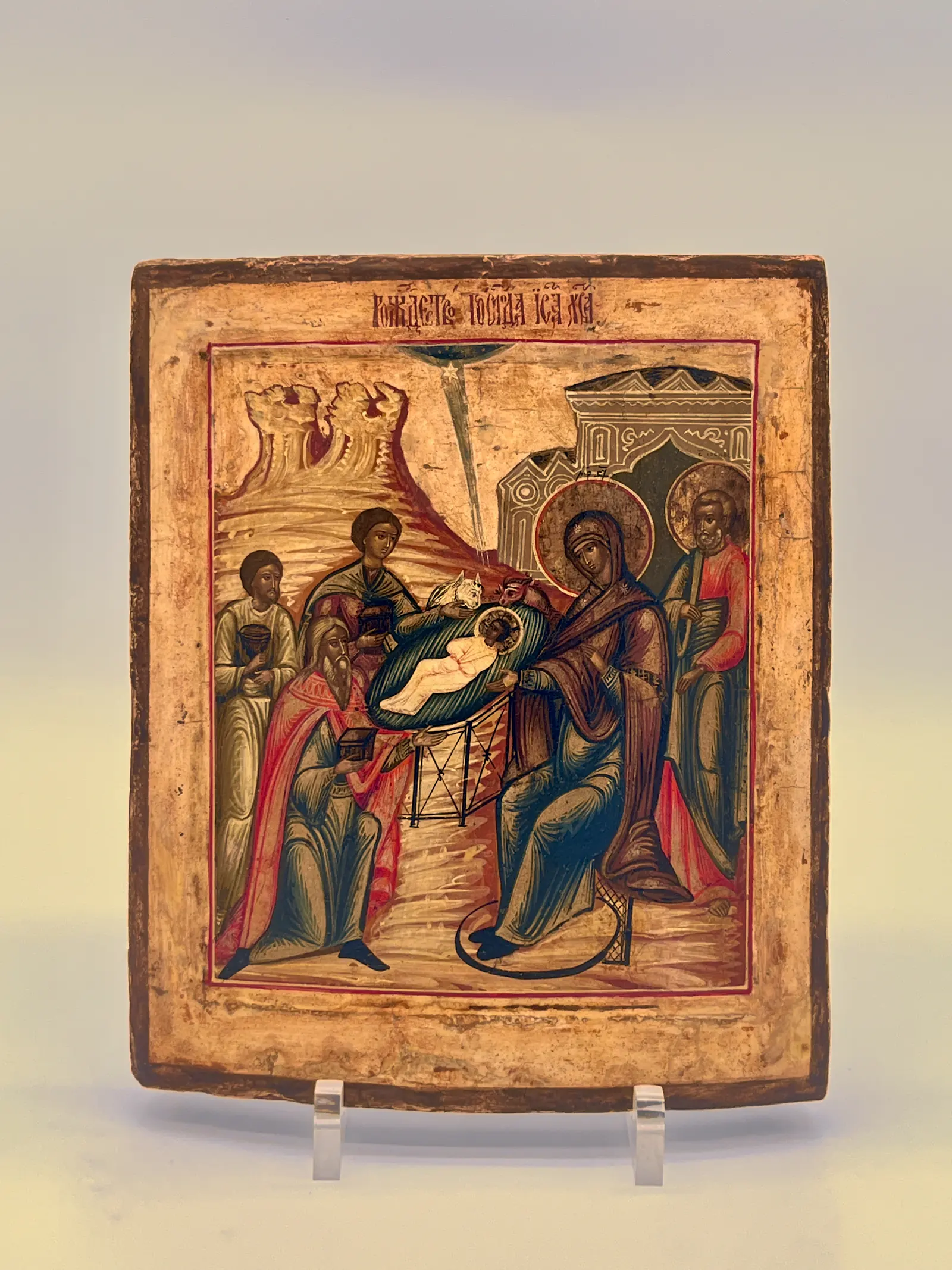
This exquisite icon depicts the Nativity of Christ, one of the most important and deeply venerated feasts of the Orthodox liturgical year. Created in Russia in the late 18th or early 19th century, it combines masterful craftsmanship with profound spiritual and theological depth.
Russian icon from around 1800, 31 × 26 cm.
This exquisite icon depicts the Nativity of Christ, one of the most important and deeply venerated feasts of the Orthodox liturgical year. Created in Russia in the late 18th or early 19th century, it combines masterful craftsmanship with profound spiritual and theological depth. The painting captivates with its refined linework, delicate color transitions, and balanced composition—hallmarks of a workshop still firmly rooted in the great traditions of the old Moscow and Yaroslavl schools of icon painting.
At the center of the composition sits the Mother of God, clothed in a deep purple mantle symbolizing her royal and maternal dignity. Her expression is contemplative and solemn, her gaze turned inward rather than toward the Child—an artistic expression of the theological understanding of the Nativity as a divine mystery transcending the human realm. The Christ Child lies swaddled on a dark, rectangular bedding that, in iconography, symbolizes the cave—not, as in Western art, a stable.
This cave represents the world shrouded in darkness, and at the same time prefigures the tomb, a prophetic reference to Christ’s future Passion and Resurrection. The manger in which the Child rests foreshadows the altar, upon which Christ, the “Bread of Life,” will be offered in sacrifice. Behind the Mother of God stands Joseph, while above the scene the heavens open. From the celestial sphere descends a single beam of divine light, symbolizing the presence of the Holy Spirit and the revelation of God in the world.
Within this light, one perceives the stylized representation of the heavenly realm from which the light of salvation enters creation. The Three Magi from the East appear in gestures of reverent adoration; one of them kneels to present his gift. Their depiction in Byzantine garments emphasizes that they represent the Gentile nations—those outside Israel—who recognize Christ as the Savior of all humankind.
In the background, architectural elements subtly suggest the city of Bethlehem, rendered not in linear perspective but in symbolic form, as is typical of Orthodox iconography—a reference to the Heavenly Jerusalem. Behind the manger, two animals are depicted: an ox and a donkey. According to the Church Fathers Jerome and Ambrose, these animals bear profound theological meaning. The ox represents the Jewish people and the Law, while the donkey symbolizes the Gentiles, those without the Law.
Together they bow before their Creator, fulfilling the prophecy of Isaiah: “The ox knows its owner, and the donkey its master’s crib” (Isaiah 1:3). A key distinction between the Orthodox and Western depictions of the Nativity lies in the setting: in Orthodox tradition, Christ is not born in a stable, but in a cave. This imagery, rooted in early Byzantine art, carries deep symbolic meaning. The cave represents the darkness of the fallen world into which Christ, the Light of Salvation, is born.
It is also a foreshadowing of the tomb, linking birth and resurrection inseparably—the divine plan of redemption conceived as a single, eternal act. The presence of the Magi and angels symbolizes the union of heaven and earth at the moment of the Incarnation. Unlike Western art, which often includes narrative and emotional details—such as shepherds, animals, or pastoral settings—Orthodox iconography conveys theology through form. The birth of Christ is presented not as a historical event, but as an eternal, divine mystery.
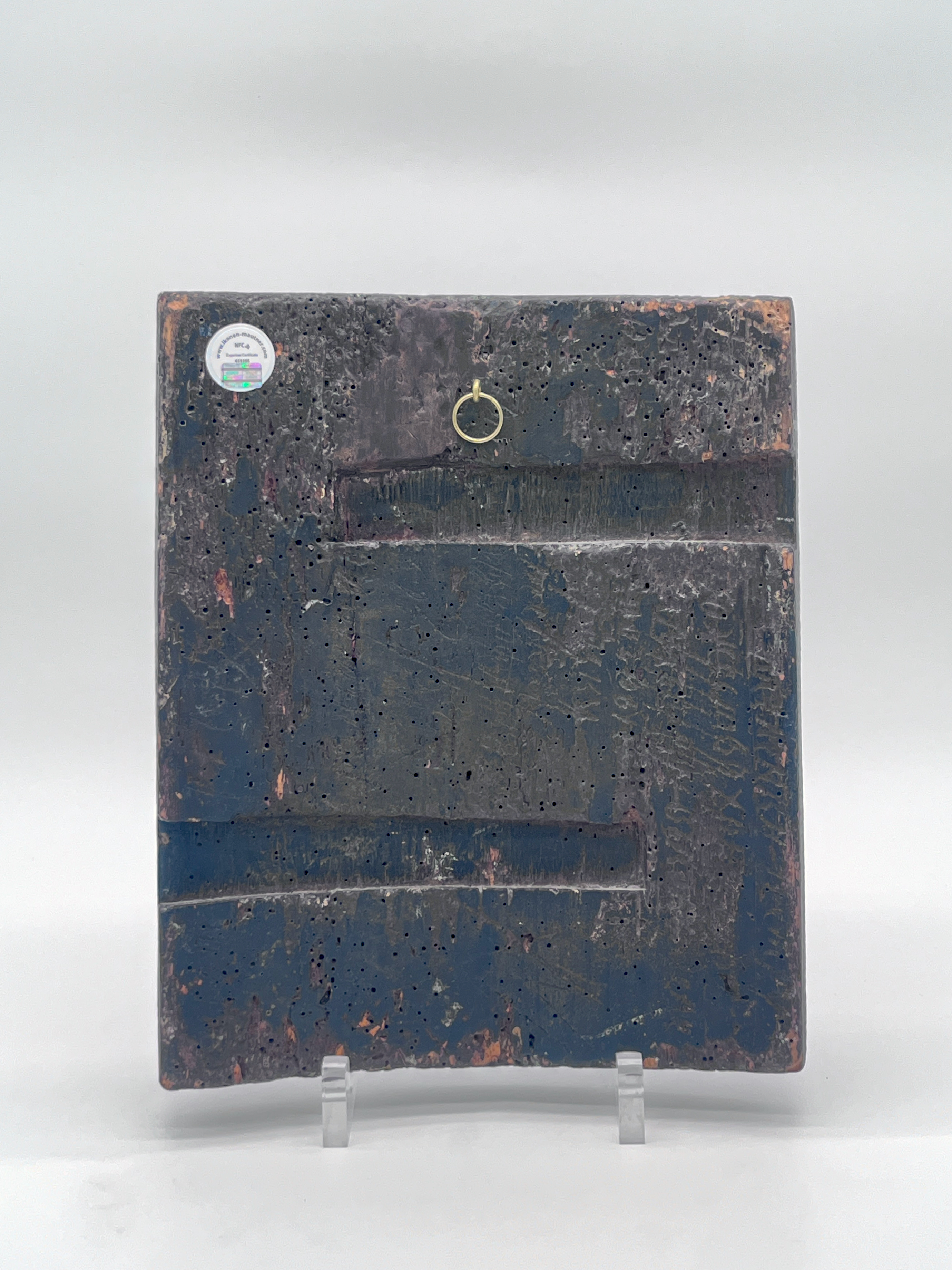
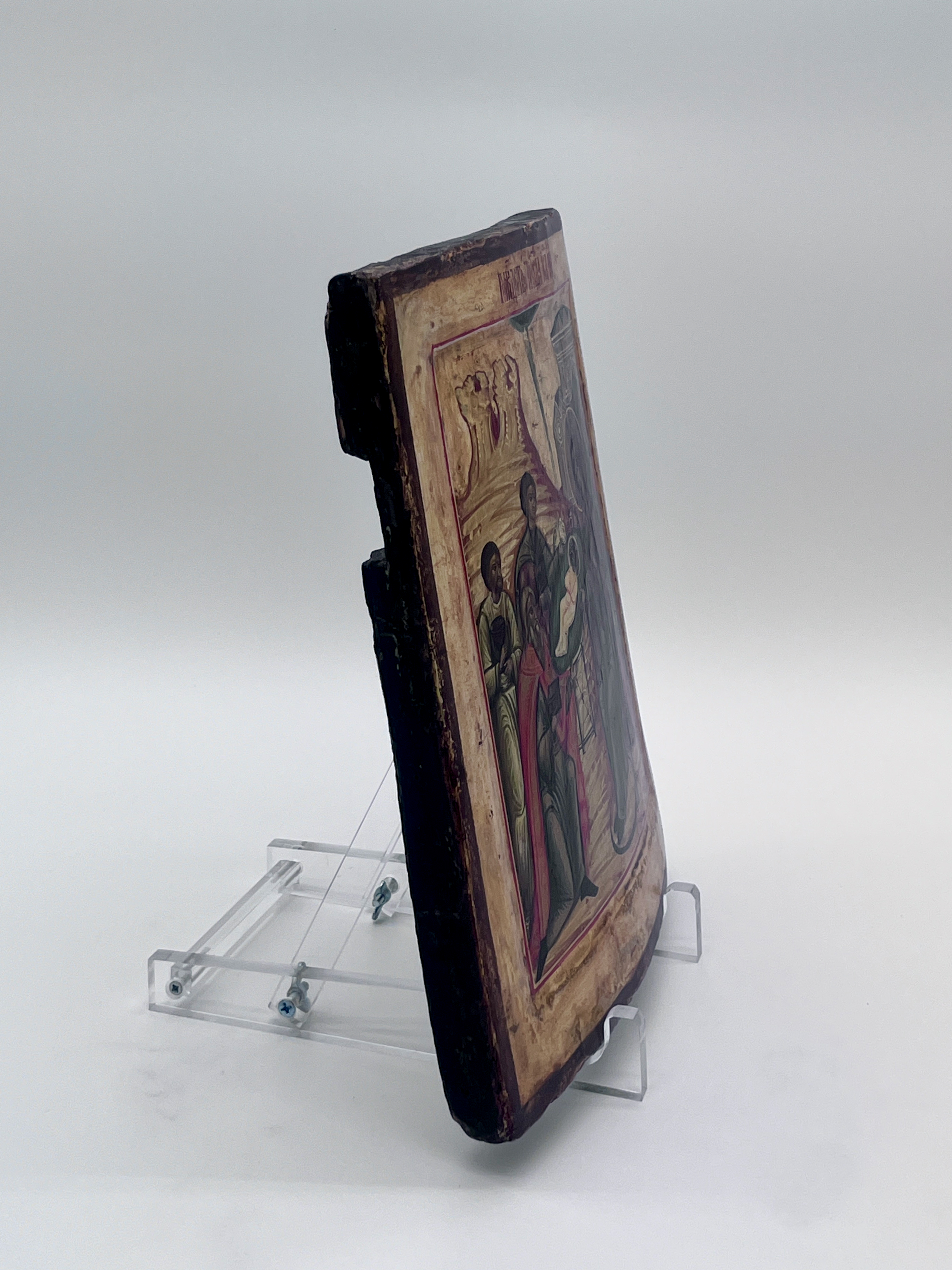
The icon dates to the late 18th or early 19th century, a period marking the final flourishing of traditional Russian icon painting before the increasing influence of Western stylistic elements. The state of preservation is excellent: the paint layer is stable, the colors remain vivid, and the surface shows a beautiful, even patina. The background of the icon was removed, allowing conservators in that time to preserve, clean, and reveal the original painted surface in all its aesthetic integrity.
In this icon, the uncovering process was performed with great care, exposing the delicate modeling of the figures, the subtle transitions of color, and the balanced harmony of the composition—restoring the work to its original clarity and radiance. This Nativity icon stands as a beautiful testament to the spiritual refinement and technical mastery of Russian icon painting at the threshold between two centuries.
Its serene composition, luminous palette, and theological symbolism make it not merely a work of art, but a visual meditation on the mystery of the Incarnation—the Light of Christ shining into the darkness of the world.
Object identity
- Object title
- Nativity of Christ with the Adoration of the Magi
- Inventory number
- 25121
- Origin or type
- Russian Icons
- Date
- Around 1800
- Dimensions
- 31 × 26 cm
- Canonical page
- https://ikonen-mautner.com/en/collection/geburt-christi-anbetung-der-koenige-25121
Learn about object identification and certificate verification
Sold — this archive record stays online for art-historical reference.