Unburnt Bush | Russian icon, 22 × 17.7 cm
High-resolution photographs are available on request. Images shown on this website may have been edited for presentation purposes. For a definitive assessment of the object, please contact us to request unedited original photographs.
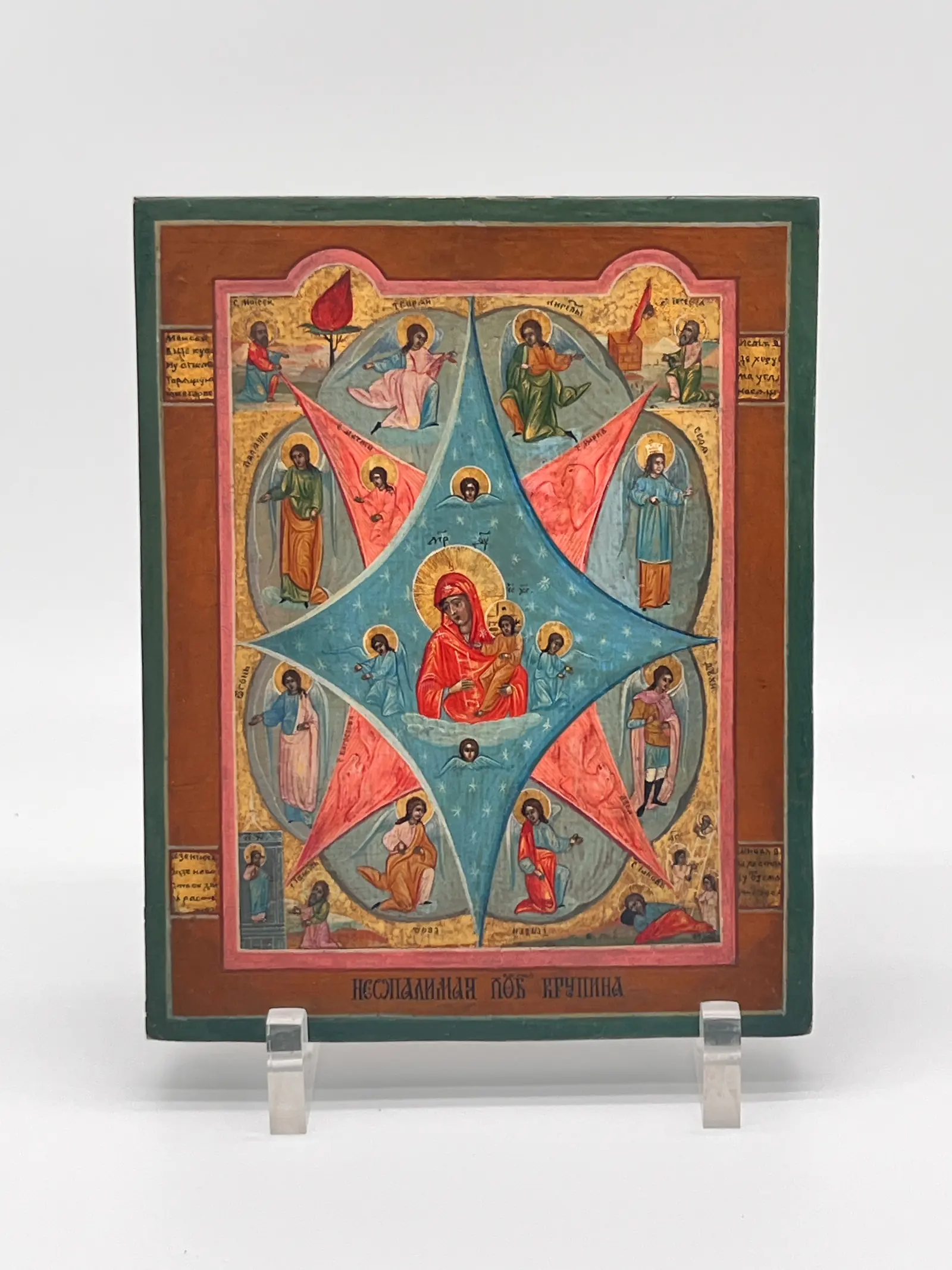
The icon of the "Burning Bush" is one of the most symbolically complex Marian depictions in Russian iconography. It developed from the 16th century onward as an expression of deep Marian devotion.
Russian icon from the 19th century, 22 × 17.7 cm.
The icon of the "Burning Bush" is one of the most symbolically complex Marian depictions in Russian iconography. It developed from the 16th century onward as an expression of deep Marian devotion. It combines Old Testament prophecy, New Testament Christology, and elements of folk religious protection symbolism. The title refers to the scene in the Book of Exodus, where Moses, on Mount Horeb, sees a bush that burns with fire but is not consumed (Ex 3:2).
In Christian interpretation, this burning yet unconsumed bush became a symbol of the Virgin Mother of God: touched by divine fire, yet remaining unscathed—a powerful image of the virginal birth of Christ. At the center of the icon is the Mother of God with the Christ Child Emmanuel, depicted in the traditional "Platytera" form (enthroned and frontal). She is enclosed within an eight-pointed star medallion, formed by two interlaced rhombuses: The red rhombus symbolizes divine fire. The blue rhombus represents human nature, or earth.
This cosmic-symbolic star rests on a circular rosette filled with angels. The four points of the lower rhombus contain the symbols of the Evangelists: Man/Angel – Matthew, Lion – Mark, Ox – Luke and Eagle – John. These symbols originate in the visions of Ezekiel (Ez 1:5–10) and the Revelation of John (Rev 4:6–8), and they represent the four Gospel writers. Their current association with the Evangelists dates back to Saint Jerome in the 4th century, who also established the canonical order of the Gospels in the New Testament.
Within the rosette and the upper points of the star, angels appear holding liturgical attributes drawn from the Akathist Hymn, one of the most important Marian hymns in the Orthodox Church. In the four corners of the icon are scenes from the Old Testament that prefigure the Virgin Birth and Mary's divine election: 1. Top left: Moses before the Burning Bush – “Moses saw a burning bush on the mountain...” → The foundational image and theological source of the icon. 2.
Bottom left: Ezekiel before the closed gate of the temple – “Ezekiel before the closed temple gate...” → A symbol of Mary's virginal integrity (Ez 44:2). 3. Top right: The Prophet Isaiah with a cherub – “Isaiah saw a cherub with a glowing coal...” → A vision of God's holiness (Is 6:6) and a foreshadowing of the Incarnation. 4. Bottom right: Jacob's Ladder – “Jacob's ladder from heaven to earth” → Mary as the connection between heaven and earth, between God and humanity.
In Russian folk belief, this icon was especially venerated as a protection against fire, lightning, and house fires. Because of the central image of the bush burning yet unconsumed, it became a beloved household icon, found in both rural and urban homes—an expression of profound Marian devotion and spiritual security.
Object identity
- Object title
- Mother of God of the Burning Bush
- Inventory number
- 24995
- Origin or type
- Russian Icons
- Date
- 19th Century
- Dimensions
- 22 × 17.7 cm
- Painting school
- Keine
- Canonical page
- https://ikonen-mautner.com/en/collection/gottesmutter-vom-unverbrennbaren-dornbusch-24995
Learn about object identification and certificate verification
Sold — this archive record stays online for art-historical reference.