Mother of God of Pskov | Vrezok icon, c. 1800
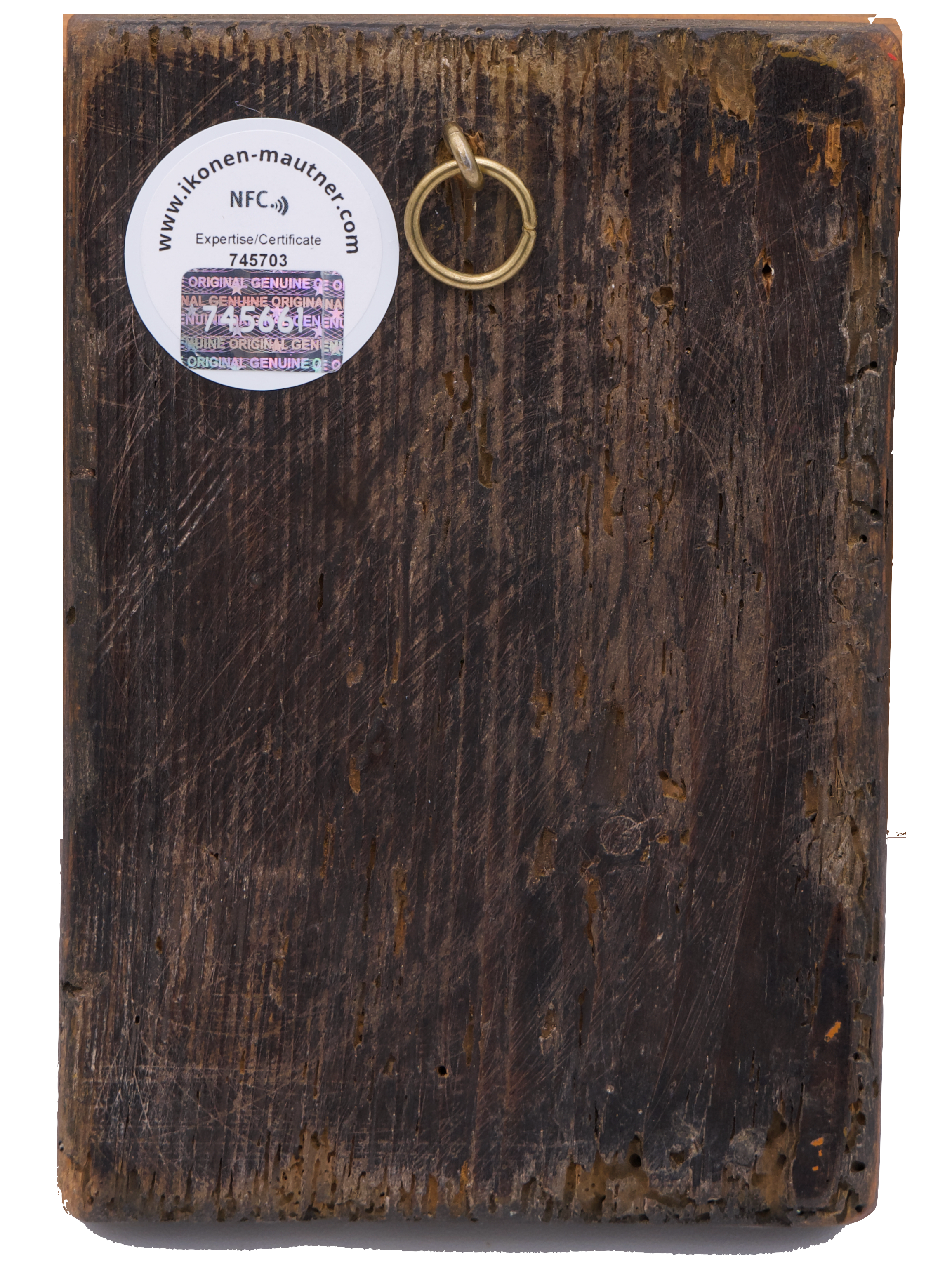
High-resolution photographs are available on request. Images shown on this website may have been edited for presentation purposes. For a definitive assessment of the object, please contact us to request unedited original photographs.
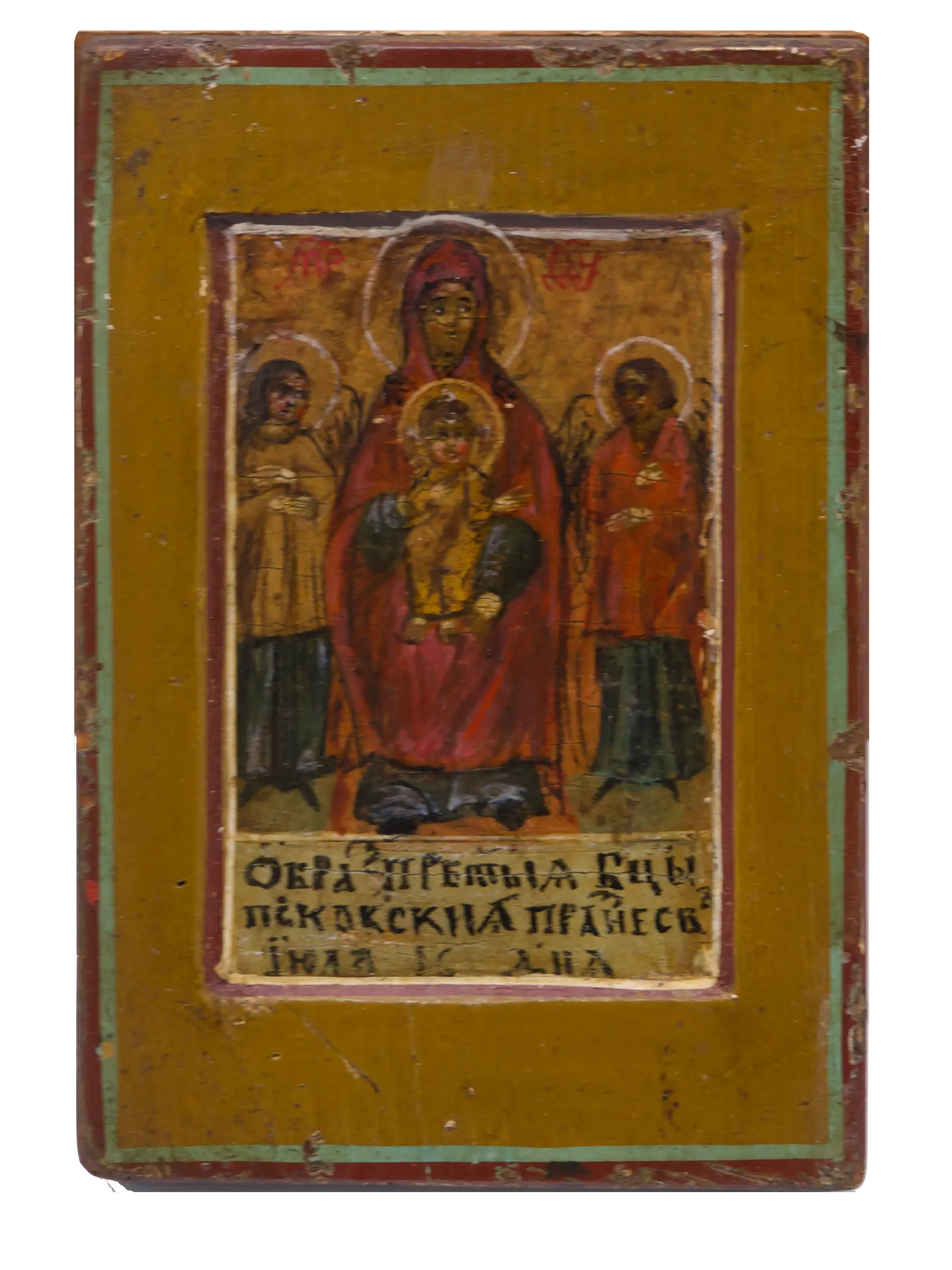
In the present fragment, the “Pskov” Mother of God is depicted—an icon variant whose name and form are closely tied to the icon-painting tradition of the northwestern Russian city of Pskov. Here, the Mother of God appears in a calm, contemplative pose, clad in a red garment.
Russian icon from around 1800, 12 × 8.5 cm.
In the present fragment, the “Pskov” Mother of God is depicted—an icon variant whose name and form are closely tied to the icon-painting tradition of the northwestern Russian city of Pskov. Here, the Mother of God appears in a calm, contemplative pose, clad in a red garment. As is typical of the Pskov tradition, her facial features reflect a gentle severity, deep seriousness, and quiet empathy. Seated on her lap is the Christ Child.
Generally, the depiction of the child Jesus not only emphasizes the close bond between mother and son, but also points theologically to Mary’s role as the “Theotokos” (God-Bearer)— the woman through whom the divine took human form. The Christ Child is shown making a gesture of blessing, underscoring His wisdom, His teaching, and His role as Savior. Flanking the Mother of God are two angels, which in Orthodox iconography serve as heavenly witnesses, attendants, and heralds of divine messages.
Their light, hovering postures, delicate garments, and radiant halos symbolize the realm of the divine and transcendent. In many icons, angels function as mediators between the viewer and the depicted sacred scene: they guide the believer’s gaze from the earthly level of observation upward into the higher spheres revealed by the icon. This Orthodox icon is known as an “ikona-vrezok,” meaning a fragment that originally belonged to a larger, more comprehensive icon composition.
The term “vrezok” comes from Russian and literally means “cut-out” or “cut-out piece.” Such fragments often resulted when larger icons were damaged by weathering or other adverse conditions. To preserve at least part of the sacred image, intact sections were cut out, thus saving them from complete loss.
Object identity
- Object title
- Mother of God of Pskov
- Inventory number
- 25096
- Origin or type
- Russian Icons
- Date
- Around 1800
- Dimensions
- 12 × 8.5 cm
- Canonical page
- https://ikonen-mautner.com/en/collection/gottesmutter-von-pskow-25096
Learn about object identification and certificate verification
Sold — this archive record stays online for art-historical reference.