Saint Joasaph of Belgorod | Icon, early 20th century
High-resolution photographs are available on request. Images shown on this website may have been edited for presentation purposes. For a definitive assessment of the object, please contact us to request unedited original photographs.
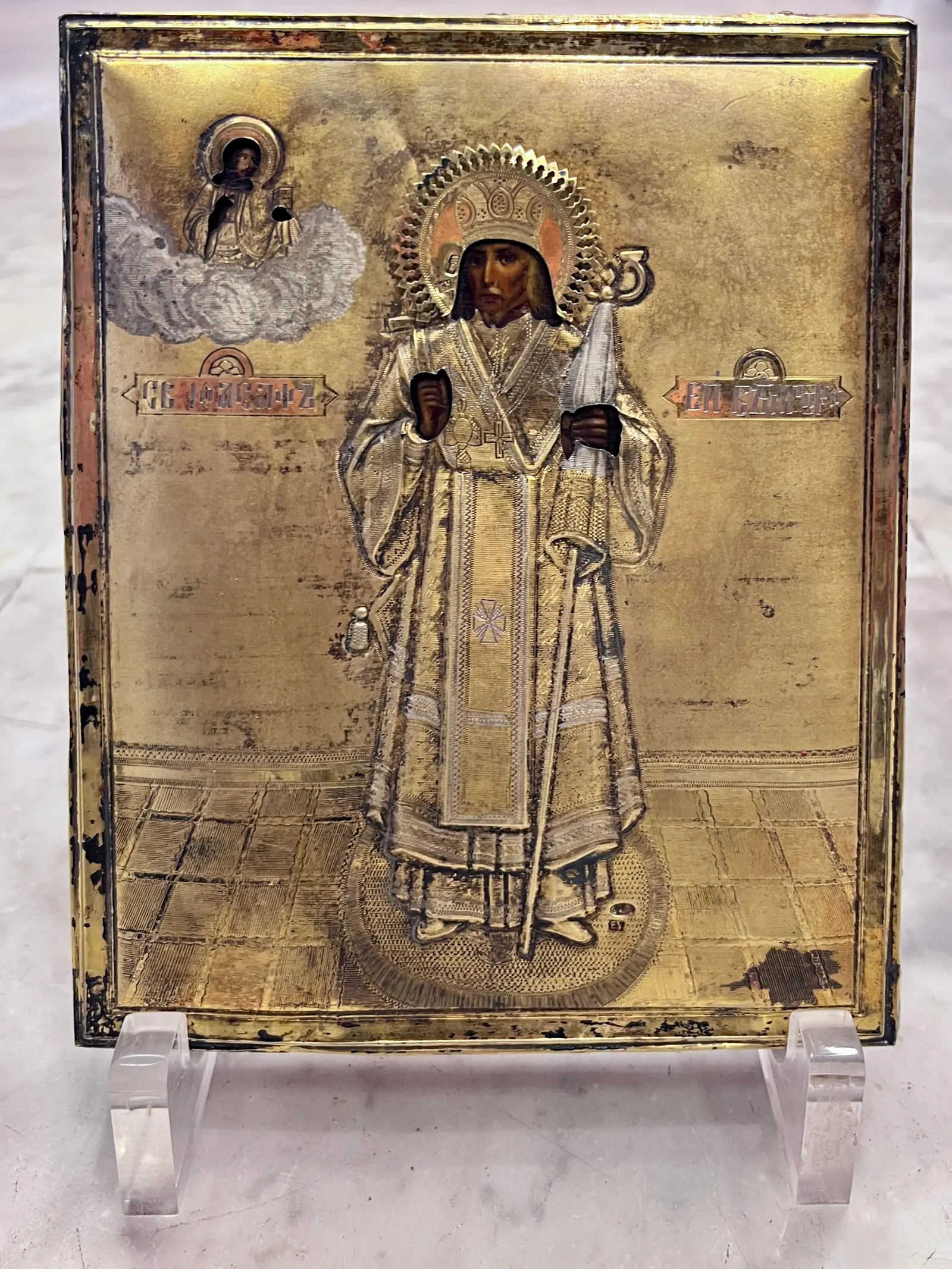
This remarkable Russian Orthodox icon of Saint Ioasaph of Belgorod unites, in an impressive way, the artistic refinement of the late Imperial period with a deeply personal spiritual history.
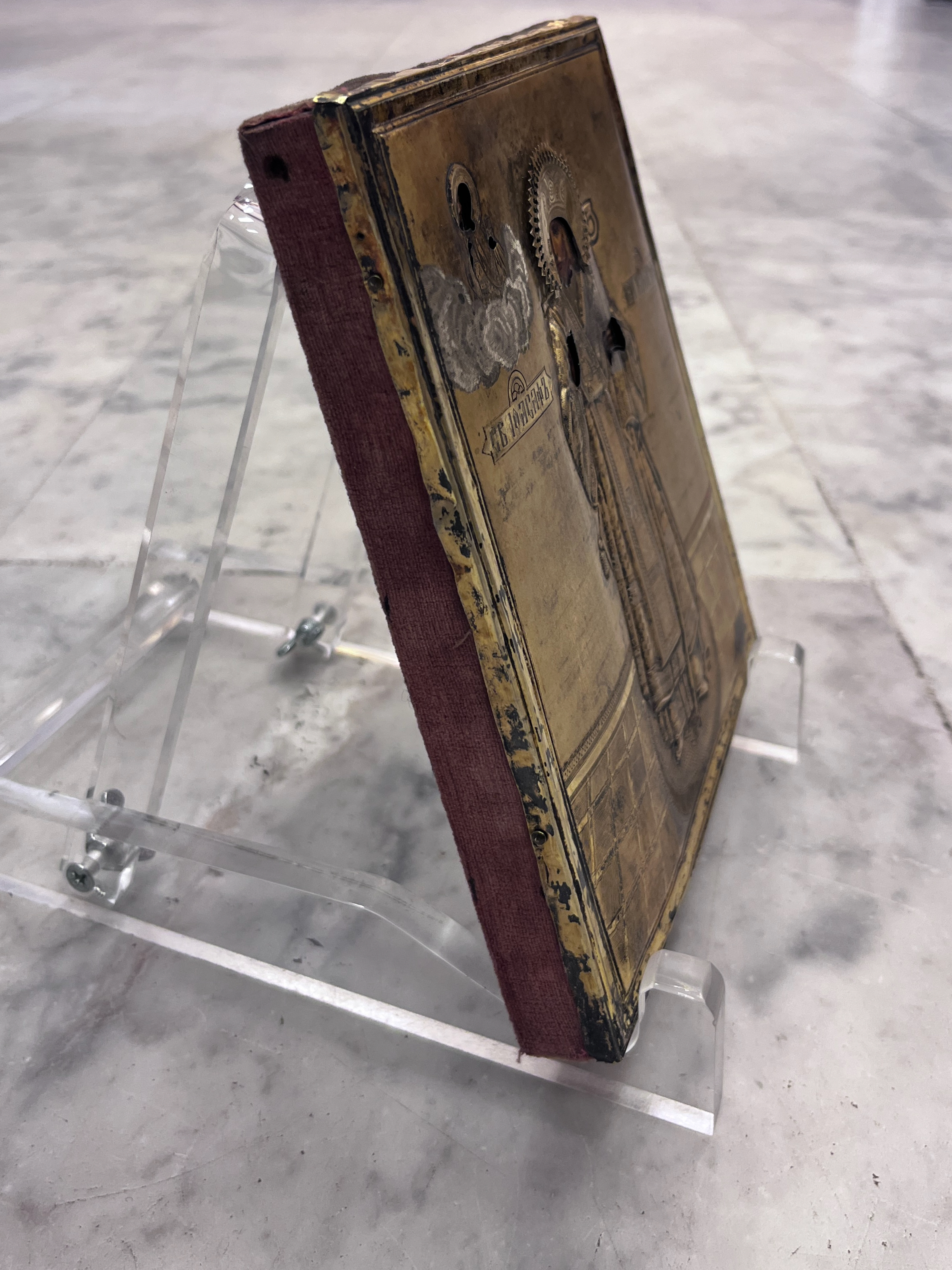
Russian icon from the early 20th century, 18 × 14.5 cm.
This remarkable Russian Orthodox icon of Saint Ioasaph of Belgorod unites, in an impressive way, the artistic refinement of the late Imperial period with a deeply personal spiritual history. The gilded silver oklad originates from Moscow, as indicated by the kokoshnik hallmark with a downward-facing profile and small triangle—an assay mark used between 1908 and 1926. The silver alloy corresponds to the Russian standard of 84 zolotniki (≈ 875/1000 fine silver). The master’s mark ЕУ (Cyrillic: E U) points to a Moscow silversmith active during this era.
Although the artisan can no longer be identified with certainty, the technical quality of the work—the precise repoussé, the fine cross-hatching, and the cleanly cut openings for the face and hands—suggests a workshop specializing in high-grade icon covers. The form of the halo and its radiant burst reflect the stylistic vocabulary of Moscow ateliers after the hallmarking reform of 1908. The icon is not fully painted: the saint’s face and hands were executed directly on the wooden panel and subsequently fitted with a custom-made oklad.
This indicates that icon and metal cover were created simultaneously—a hallmark of quality that points to a deliberate, unified composition. The delicate, honey-toned visage of Saint Ioasaph stands in harmonious contrast to the ornate richness of the oklad, whose gilding remains well preserved and shows a noble, even patina. Saint Ioasaph of Belgorod (1705–1754) is among the most beloved Russian miracle-workers of the 18th century. As Bishop of Belgorod he was revered for his charity, spiritual wisdom, and service to the poor and the sick.
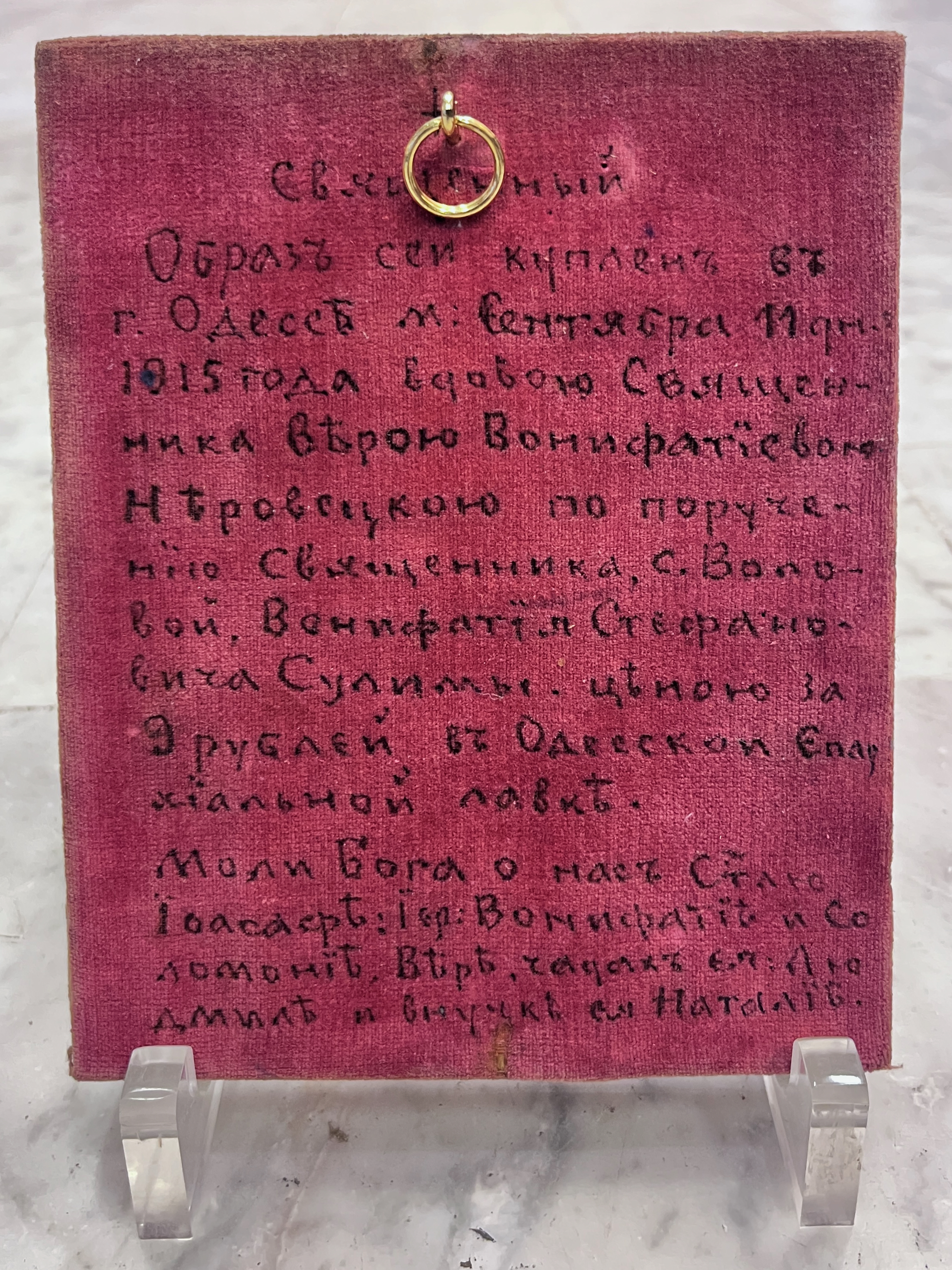
His tomb soon became a pilgrimage site, with numerous healings attributed to his intercession. His canonization in 1911 sparked a renewed wave of devotion—precisely in the years when this icon was likely created. Icons of Saint Ioasaph were cherished especially as protective images for families, the sick, and those undertaking journeys. The personal character of this piece is revealed in the handwritten dedication on the reverse, which offers a vivid glimpse into its early history.
Translated from Russian, it reads: “This holy image (icon) was purchased in the city of Odessa in the month of September, on the 11th day of the year 1915, by the widow of a priest, Vera Bonifatieva Nerovezka, with the blessing of the priest Bonifatius Stefanovič Sulime of the village of Volovoj, for the price of 9 rubles, in the shop of the Odessa Eparchy. Pray to God for us, holy Joasaph: Priest Bonifatius and Salomon, Vera and her child Ludmila, and her grandchild Natalija.”
This dedication transforms the icon into a document of family devotion: it was not acquired anonymously, but chosen deliberately, blessed, and entrusted to the spiritual care of an entire household. In 1915—amid the turmoil of the First World War—many believers turned to Saint Ioasaph as an intercessor in uncertain times. The detailed listing of names shows that this icon was intended not merely as an object of veneration but as a spiritual safeguard for several generations.
Today the icon remains in a dignified, age-appropriate condition: the gilding has developed a soft patina, the engravings are crisp, and the painting of the saint’s face has preserved its original warmth. It stands as a small yet striking testament to Russian saintly devotion on the eve of the fall of the Empire—an object in which faith, craftsmanship, and personal history are intimately intertwined.
Object identity
- Object title
- Saint Joasaph of Belgorod
- Inventory number
- 25172
- Origin or type
- Russian Icons
- Date
- Around 1900 / Modern
- Dimensions
- 18 × 14.5 cm
- Canonical page
- https://ikonen-mautner.com/en/collection/hl-ioasaph-von-belgorod-25172
Learn about object identification and certificate verification
Sold — this archive record stays online for art-historical reference.