Saint Nicholas | Silver oklad, hallmarked Moscow 1882
High-resolution photographs are available on request. Images shown on this website may have been edited for presentation purposes. For a definitive assessment of the object, please contact us to request unedited original photographs.
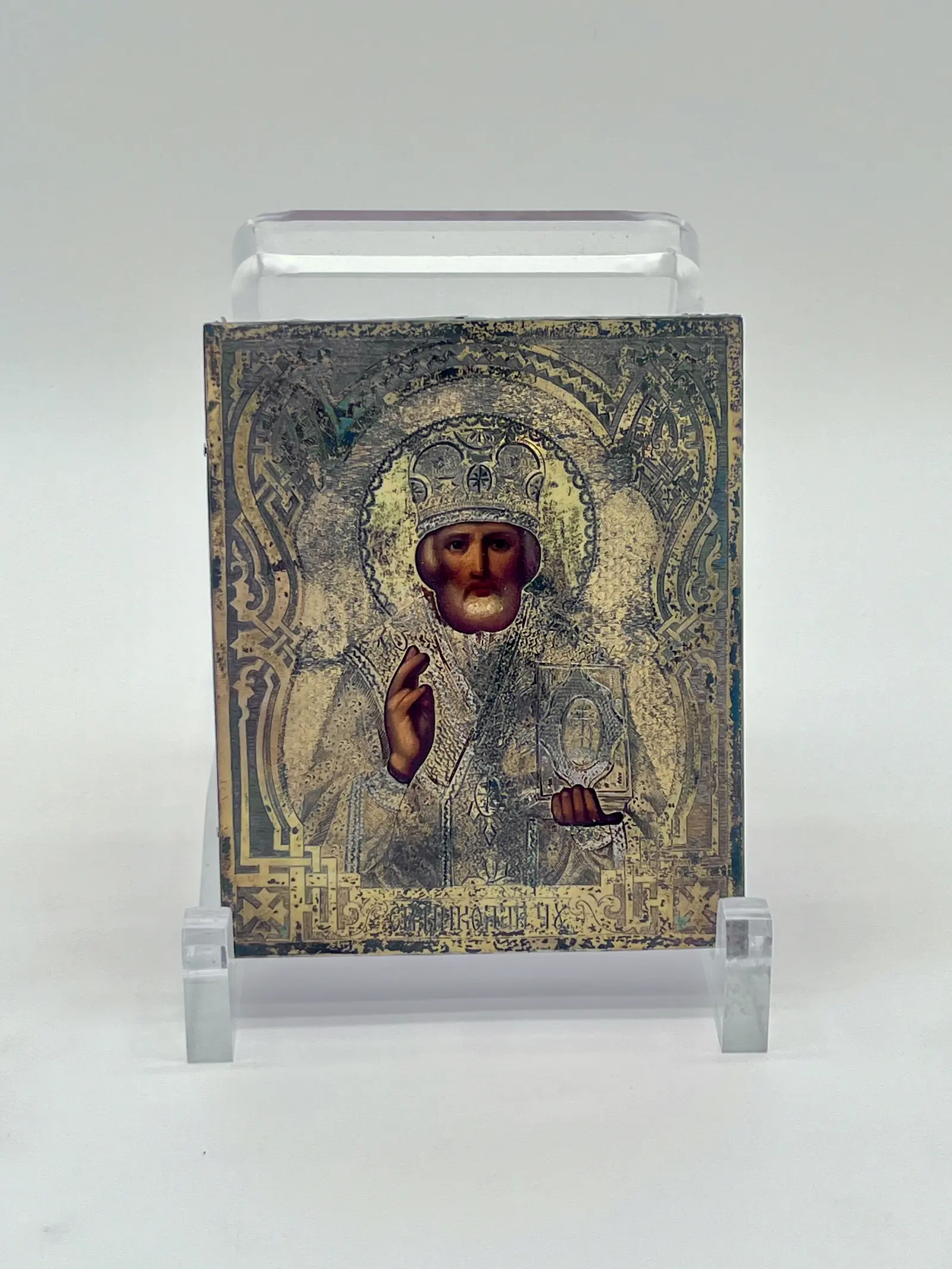
This exquisite icon depicts Saint Nicholas of Myra, the Wonderworker, in the classical half-length form: blessing with his right hand and holding the open Gospel in his left. The painting is deliberately limited to the face and hands, while the vestments, miter, halo, and border are entirely covered by the gilded silver oklad (revetment).
Russian icon from the 19th century, 13.5 × 11.3 cm, with a silver oklad.
This exquisite icon depicts Saint Nicholas of Myra, the Wonderworker, in the classical half-length form: blessing with his right hand and holding the open Gospel in his left. The painting is deliberately limited to the face and hands, while the vestments, miter, halo, and border are entirely covered by the gilded silver oklad (revetment). This “partially painted” concept is characteristic of icons whose image and metal covering were created simultaneously.
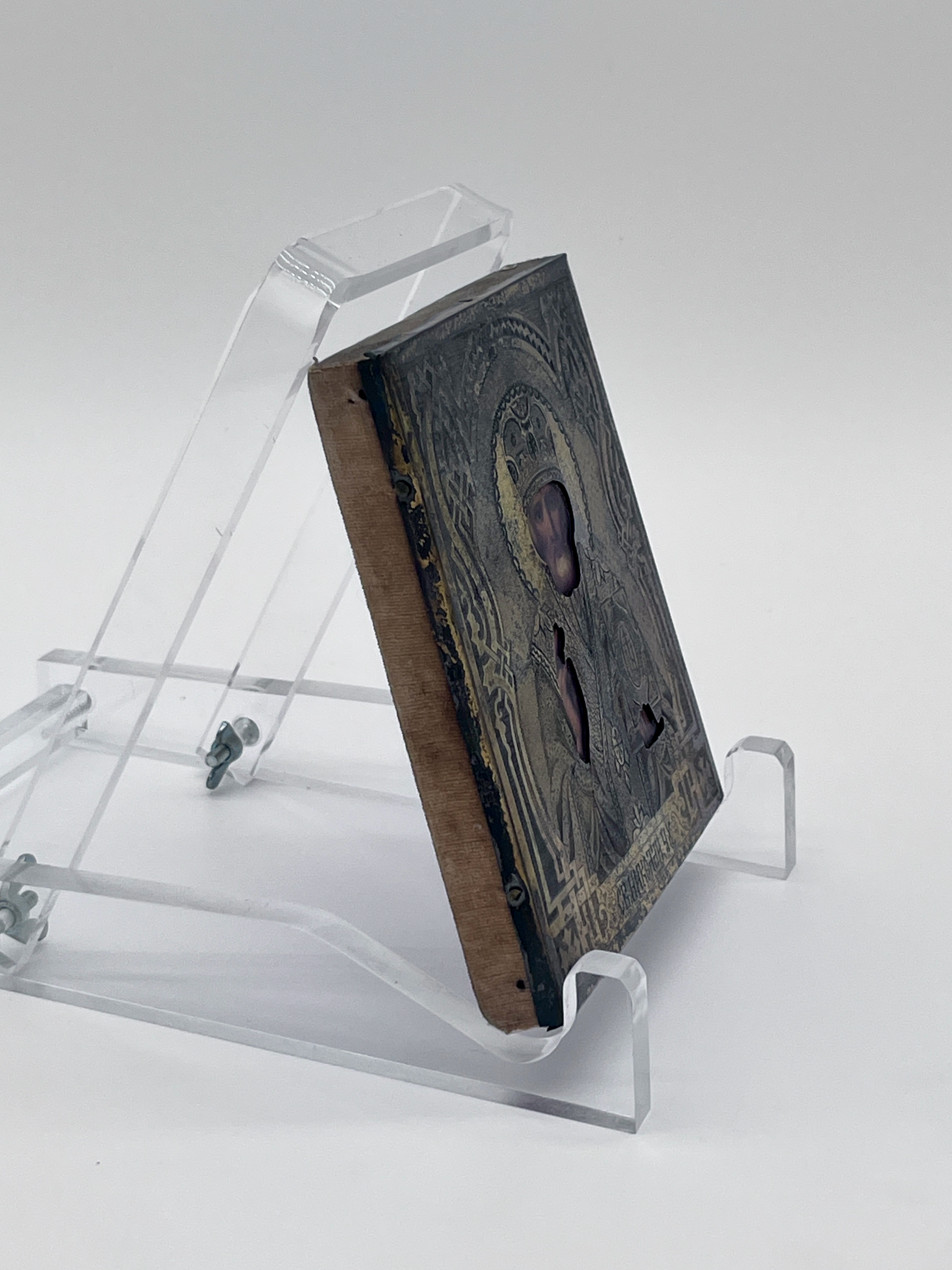
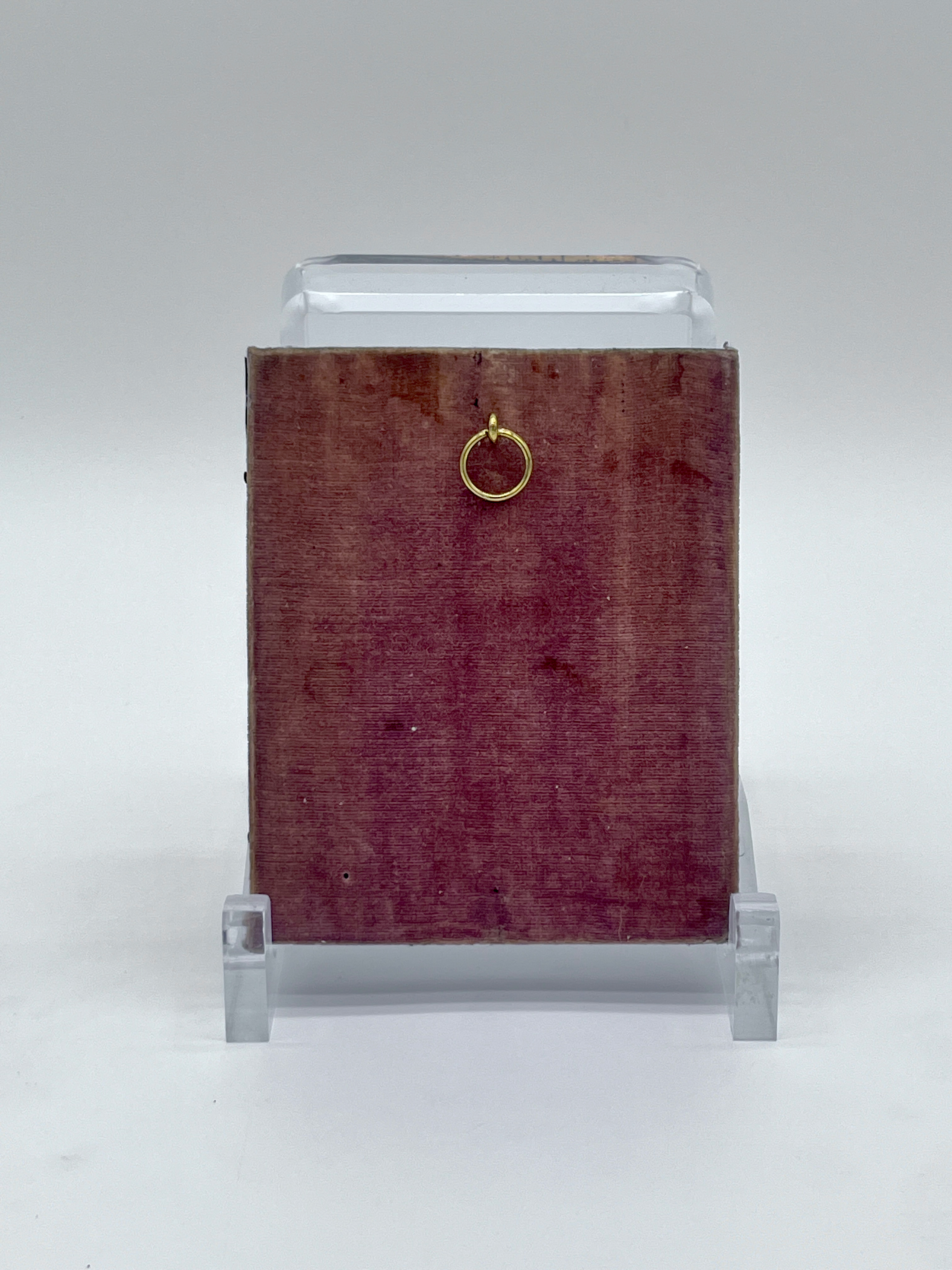
The wooden panel and the oklad were conceived as a single unit; there are no later cut-out openings—the painting was originally executed only where the saint’s face and hands would remain visible. At the center stands Saint Nicholas of Myra (Nikolaos Thaumaturgos) in the traditional half-length depiction. With his right hand he bestows the episcopal blessing; in his left he holds the Gospel.
The background and halo are richly ornamented with delicate foliate designs and geometric punching, while the surrounding border displays a dense, symmetrical interlace pattern. Saint Nicholas of Myra, also known as Nicholas the Wonderworker, lived in the 4th century in Lycia (modern-day Turkey). As Bishop of Myra, he participated in the First Ecumenical Council of Nicaea (325 AD), where he fervently opposed Arianism.
His life is interwoven with legends and miracles that made him one of the most beloved saints of East and West: he saved three innocent men from execution by halting the executioner’s sword; secretly provided dowries for three impoverished maidens—the origin of the custom of Nicholas as a bringer of gifts; calmed a storm at sea, becoming the patron of sailors. He healed the sick, freed prisoners, and came to the aid of those in distress.
After his death, his body was buried in Myra, but in 1087 sailors brought his relics to Bari, Italy, where they remain in the Basilica di San Nicola. In the Orthodox Church, Nicholas is venerated as Thaumaturgos—the “Wonderworker,” whose prayers and intercessions perform miracles. No other saint is so widely revered in the Orthodox world: countless churches and monasteries bear his name, and nearly every Russian household once possessed an icon of Saint Nicholas.
He is one of Christianity’s most universal patrons— protector of sailors and fishermen, patron of children (origin of the Western St. Nicholas tradition), guardian of merchants, pharmacists, and lawyers for his sense of justice and benevolence, and helper of travelers and prisoners in danger and distress. His feast day, December 6 (Gregorian calendar) / December 19 (Julian calendar), is one of the major feasts of the Orthodox year. The oklad is made of Russian silver of 84 zolotniki (approximately 875/1000 fine silver), as confirmed by the “84” hallmark.
The Moscow city mark with Saint George slaying the dragon indicates its origin. The assayer’s mark “A•K 1882” identifies the Moscow assay master active in that year, possibly Aleksei A. Kovalev (1875–1894). The slightly worn maker’s mark “д.С.” (Cyrillic D.S.) denotes the silversmith’s workshop, possibly that of Dmitrij Sergeev. The surface is richly engraved with foliage, hatching, and ornamental bands, partly punched and then gilded.
In the late 19th century, gilding was often applied electrochemically (galvanogilding), though traditional fire-gilding with mercury amalgam was also used. The fine chisel work on the miter, omophorion, and halo imparts luminous plasticity, making the painted face appear to emerge from the metal. The oklad shows almost no abrasion; the gilding is even and the engravings crisp—signs of careful preservation and minimal liturgical wear.
This Moscow work from 1882 unites the austerity of Byzantine iconography with the refined ornamentation of late imperial Russian silversmithing. The simultaneous creation of painting and oklad, the excellent state of preservation, and the fully legible hallmarks make this icon a distinguished collector’s piece—both a devotional image and a masterwork of Russian goldsmithing.
Object identity
- Object title
- Saint Nicholas, Wonderworker of Myra
- Inventory number
- 25144
- Origin or type
- Russian Icons
- Date
- 19th Century
- Dimensions
- 13.5 × 11.3 cm
- Oklad
- Silver Oklad
- Canonical page
- https://ikonen-mautner.com/en/collection/hl-nikolaus-25144
Learn about object identification and certificate verification
Sold — this archive record stays online for art-historical reference.