Saint Panteleimon | Russian icon, 31.5 × 26.5 cm
High-resolution photographs are available on request. Images shown on this website may have been edited for presentation purposes. For a definitive assessment of the object, please contact us to request unedited original photographs.
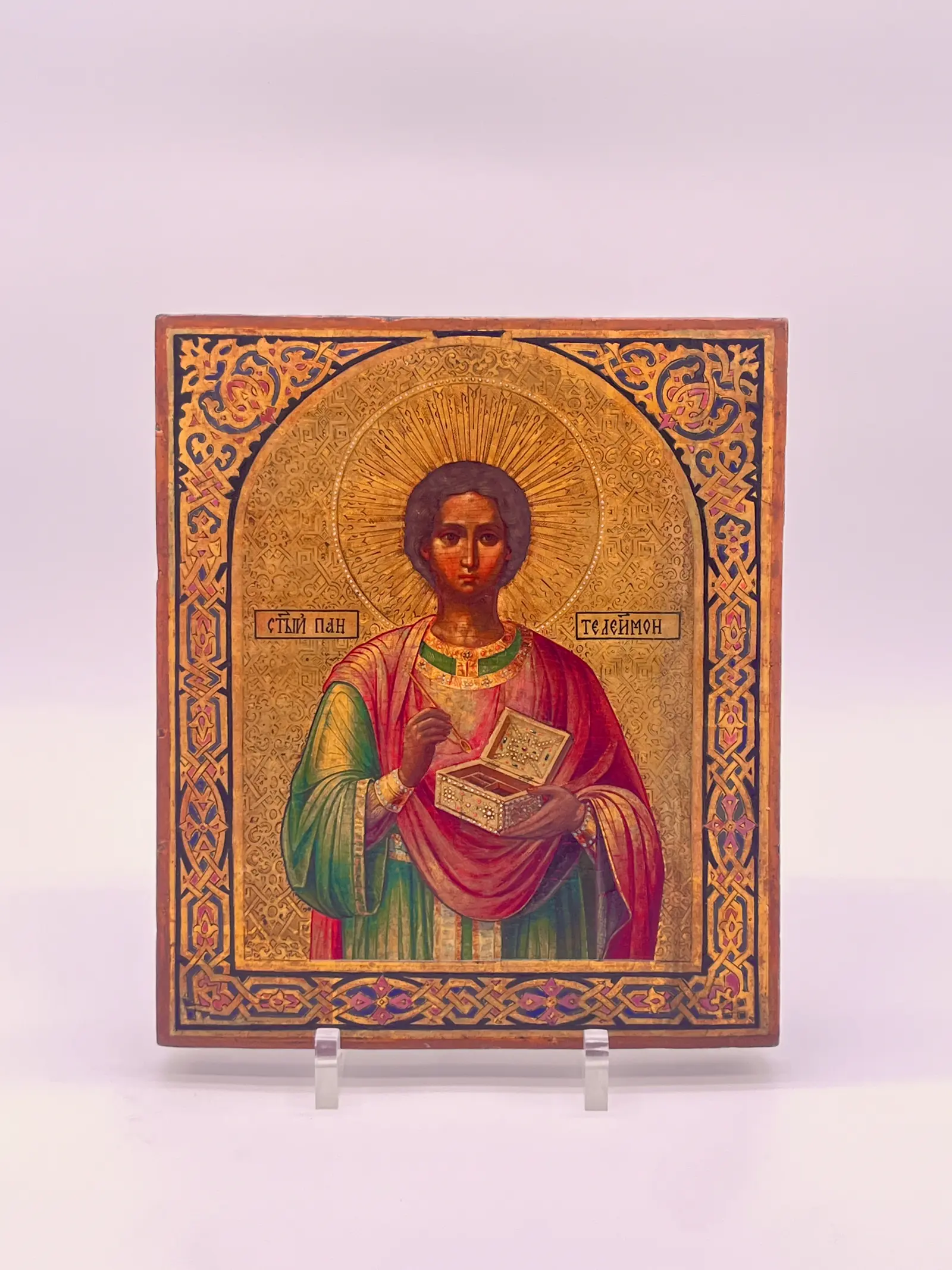
This magnificent icon depicts Saint Panteleimon, one of the most beloved saints of the Orthodox Church and the foremost patron of physicians, pharmacists, and the sick. The work dates from the 19th century and captivates with its fine, precise painting style, harmonious color palette, and radiant, burnished gold background.
Russian icon from the 19th century, 31.5 × 26.5 cm.
This magnificent icon depicts Saint Panteleimon, one of the most beloved saints of the Orthodox Church and the foremost patron of physicians, pharmacists, and the sick. The work dates from the 19th century and captivates with its fine, precise painting style, harmonious color palette, and radiant, burnished gold background. The richly punched gilding lends depth and vibrant luminosity to the surface. The saint is shown in a frontal half-length figure—calm, dignified, and youthful, with an expression of gentle kindness.
In his right hand, he holds a small spatula or ointment spoon; in his left, a tiny medicine box (pharmakion). These are his traditional attributes, symbolizing his role as a Christian healer and miracle-worker who brought healing to both body and soul. Saint Panteleimon (Greek Παντελεήμων, “the All-Merciful”) was born in the late 3rd century in Nicomedia (modern-day Izmit, Turkey). His father, Eustorgios, was a pagan; his mother, Eubula, was a Christian who raised him in the faith.
After her early death, Panteleimon drifted away from Christianity and began studying medicine under a renowned physician named Euphrosynos. His path crossed that of the priest Hermolaos, a Christian who guided him back to faith. According to legend, Panteleimon once witnessed a child die from a snake bite. At Hermolaos’ urging, he prayed to Christ—the child revived, and the snake died. This miracle led to his complete conversion.
After baptism, he received the name Panteleimon (“the All-Compassionate”), having originally been called Pantoleon (“the All-Lionhearted”). From then on, he healed the sick in Christ’s name, accepted no payment for his services, and gave his possessions to the poor. He became the very embodiment of the Christian physician, uniting medical skill with faith and mercy. During the persecutions of Emperor Maximian (around 305 AD), Panteleimon was denounced and tortured for healing in the name of Jesus.
He miraculously survived multiple tortures—his wounds closed, instruments broke, and fire was extinguished. Eventually, he was beheaded. According to legend, milk flowed from his wound instead of blood, and the olive tree to which he was tied blossomed. His relics soon became some of the most venerated in the East, and he was proclaimed the patron of physicians, pharmacists, the sick, and caregivers. His principal relics are preserved on Mount Athos, in the Monastery of Saint Panteleimon, which bears his name.
In the icon, the saint wears rich yet simple garments—a green tunic and a purple mantle symbolizing royal dignity in Christ. His youthful face, serene gaze, and gentle calm express the purity and mercy he embodies. The ointment spatula in his right hand represents both his medical craft and the divine instrument through which he dispensed healing grace. The small medicine box in his left hand refers to the remedies he blessed with faith. Symbolically, it signifies the spiritual healing that Christ himself bestows—the physician of souls and bodies.
The gilded background behind the figure is of exceptional refinement: delicate ornaments, geometric motifs, and floral borders make the light shimmer in a thousand reflections. The saint’s halo is richly decorated with rays—a sign of the divine light emanating from him. Like Saints Cosmas and Damian, Panteleimon belongs to the Anargyroi, the “Unmercenary Healers.” While Cosmas and Damian, as brothers, embody active charity, Panteleimon represents the more mystical aspect of healing—the union of medical art and divine grace.
He thus stands between earthly science and heavenly compassion: his hands touch the wounds of humanity, yet his power to heal flows from prayer. In Orthodox theology, he is seen as a “bridge between earthly and heavenly medicine.” For this reason, he is venerated in hospitals, pharmacies, and monasteries, and his feast day (July 27/August 9 according to the Gregorian calendar) holds special significance throughout the Orthodox world.
The fine execution, radiant gold ground, and clarity of iconography make this piece one of the most beautiful depictions of Saint Panteleimon—an icon that truly embodies the light of mercy and healing.
Object identity
- Object title
- Saint Great Martyr Panteleimon
- Inventory number
- 25166
- Origin or type
- Russian Icons
- Date
- 19th Century
- Dimensions
- 31.5 × 26.5 cm
- Painting school
- Keine
- Canonical page
- https://ikonen-mautner.com/en/collection/hl-panteleimon-25166
Learn about object identification and certificate verification
Sold — this archive record stays online for art-historical reference.