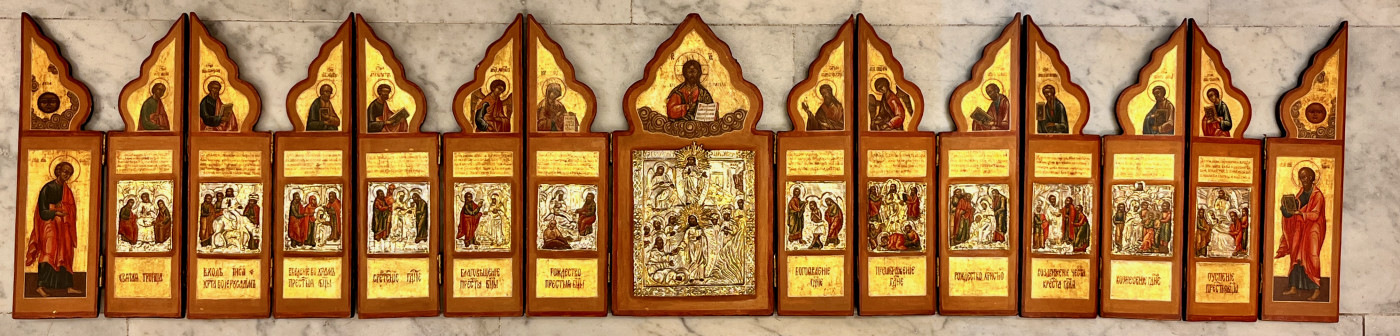
Iconostasis with 3 Marian images | Russia, 19th century
High-resolution photographs are available on request. Images shown on this website may have been edited for presentation purposes. For a definitive assessment of the object, please contact us to request unedited original photographs.
Price on request
Russian multi-panel icon from the 19th century featuring three miracle-working Marian icons and several beloved Orthodox saints. The composition unites themes of consolation, repentance, protection, marriage, and family life within a remarkably harmonious devotional image.
Russian icon from the 19th century, 136 × 31 cm, with a silver oklad.
This fine nineteenth-century Russian multi-panel icon combines some of the most beloved Marian images and saints of the Orthodox world within a single devotional composition. Icons of this type were often intended for private prayer and allowed their owners to seek the intercession of several patron saints simultaneously. The carefully selected group of figures suggests a particular emphasis on family protection, marital harmony, spiritual healing, and divine assistance. The upper register is dedicated to the Mother of God.
On the left appears the icon of the Mother of God “Unexpected Joy,” based on a famous Russian miracle story centered on repentance, forgiveness, and conversion. At the center is the Mother of God “Softener of Evil Hearts,” also known as the “Seven Swords” icon. The seven swords symbolize the sorrows of the Virgin and her power to soften hatred, discord, and hardened hearts. On the right is the Mother of God “Seeker of the Lost,” a revered image associated with divine help for those facing despair, danger, or seemingly hopeless circumstances.
The middle register features three of the most beloved saints in Orthodox Christianity. Saint Barbara the Great Martyr appears on the left as a protector against sudden death and a powerful intercessor in times of distress. At the center stands Saint Nicholas of Myra, one of the most universally venerated saints of the Christian world and patron of travelers, families, and those in need. On the right is Saint Catherine of Alexandria, renowned as a patron saint of wisdom, learning, and steadfast faith.
The lower register is particularly devoted to marriage and family life. It includes Saints Gurias, Samonas, and Habib of Edessa, who are traditionally invoked for peace within marriage and family relationships. Nearby stands the Holy Guardian Angel, protector and guide of every Christian believer. At the center are Saints Peter and Fevronia of Murom, the foremost Orthodox patrons of marriage, fidelity, and family life. Completing the composition are Saint Julitta with her son Quiricus and Saint Agrippina of Rome.
The icon’s refined painting technique, harmonious color palette, and carefully executed figures reflect the high quality of nineteenth-century Russian devotional art. Theologically, it brings together themes of mercy, repentance, family unity, spiritual consolation, and divine protection, making it both a profound object of devotion and a remarkable example of Orthodox iconography.
Depicted Saints and Feast Days Upper Register – Marian Icons * Mother of God “Unexpected Joy” – December 9 * Mother of God “Softener of Evil Hearts” (Seven Swords Icon) – celebrated on various local feast days, most commonly February 13 / August 26 * Mother of God “Seeker of the Lost” (Recovery of the Perishing) – February 18 (February 5, Old Style) Middle Register * Saint Barbara the Great Martyr – December 17 (December 4, Old Style) * Saint Nicholas the Wonderworker of Myra – December 19, May 22, and August 11 (Old Style dates: December 6, May 9, July 29) * Saint Catherine of Alexandria – December 7 (November 24, Old Style) Lower Register * Saints Gurias, Samonas, and Habib of Edessa – November 28 (November 15, Old Style) * Holy Guardian Angel – no specific feast day; commemorated throughout the liturgical year * Saints Peter and Fevronia of Murom – July 8 (June 25, Old Style) * Saint Julitta and Saint Quiricus – July 28 (July 15, Old Style) * Saint Agrippina of Rome – July 6 (June 23, Old Style) Principal Themes of the Icon: Family harmony, marital fidelity, repentance, protection from misfortune, spiritual consolation, and the intercession of the Mother of God.
Object identity
- Object title
- Iconostasis
- Inventory number
- 24743
- Origin or type
- Icons with Silver Oklad
- Date
- 19th Century
- Dimensions
- 136 × 31 cm
- Oklad
- Silver Oklad
- Canonical page
- https://ikonen-mautner.com/en/collection/ikonostase-24743
Learn about object identification and certificate verification