Easter, Great Feasts and Holy Week | Russian icon c. 1800
High-resolution photographs are available on request. Images shown on this website may have been edited for presentation purposes. For a definitive assessment of the object, please contact us to request unedited original photographs.
Price on request
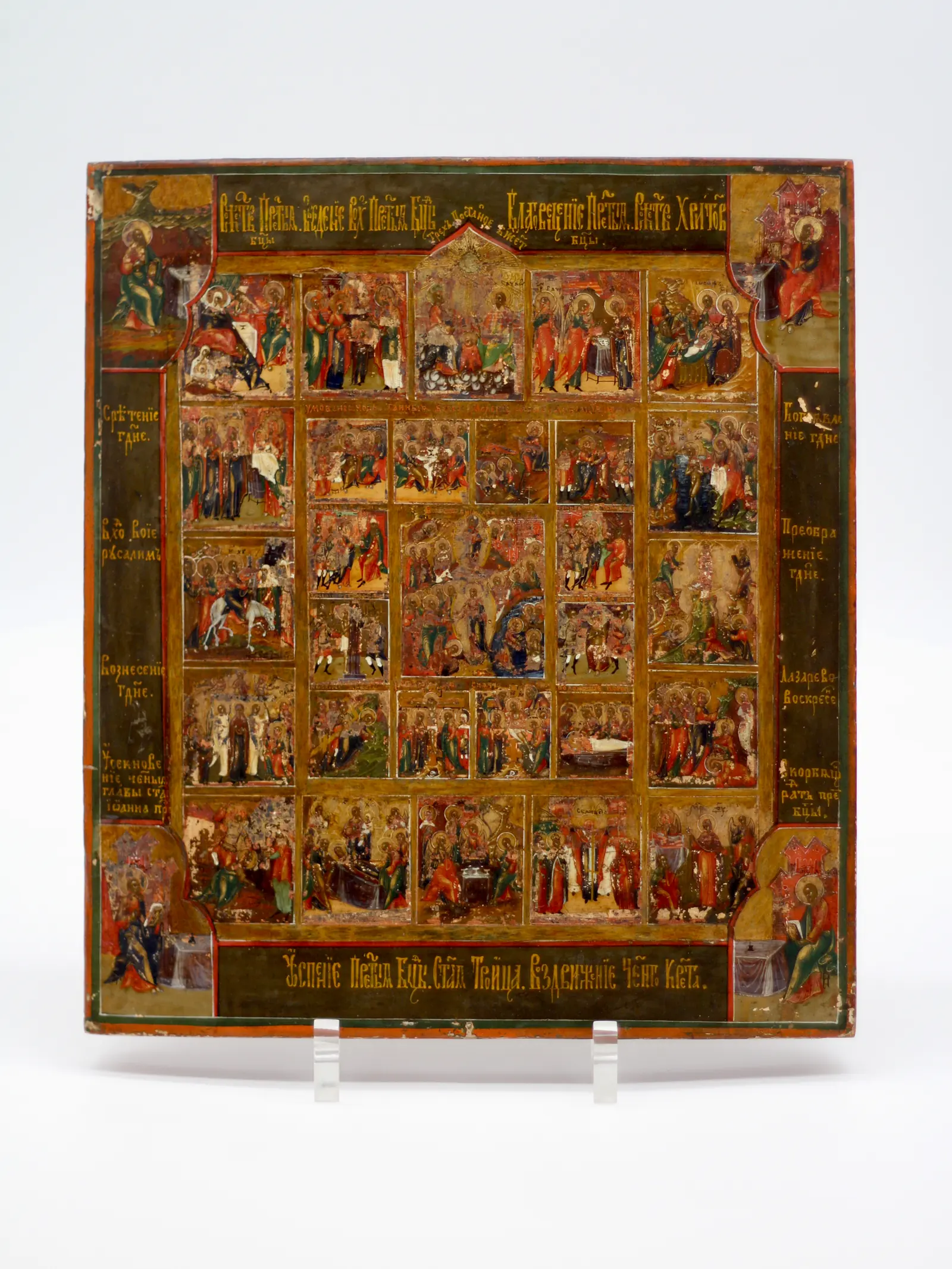
Exceptional Russian icon dating to around 1800 depicting the Resurrection of Christ, the Twelve Great Feasts, four additional feast days, the scenes of Holy Week, and the Four Evangelists. This complex composition presents almost the entire history of salvation within a single theological image.
Russian icon from around 1800, 35.5 × 31 cm.
This extraordinary Russian icon dating to around 1800 belongs to the most complex forms of Orthodox feast-day iconography. At its center stands the Resurrection of Christ in its traditional Orthodox form as the Descent into Hades. Christ stands upon the shattered gates of the underworld and raises Adam and Eve from their graves. Behind them follow the righteous of the Old Covenant, led by Saint John the Baptist and an angel.
This scene symbolizes Christ’s ultimate victory over death, sin, and corruption and forms the theological focus of the entire composition. Additional scenes further develop the Easter theme. In the upper left appears Saint Peter at the Empty Tomb as witness to the Resurrection. In the lower right Christ meets Peter at the Sea of Galilee and reaffirms his apostolic mission. The four corners contain the Evangelists Matthew, Mark, Luke, and John, whose writings preserve the Gospel message. The outer frame contains sixteen feast and holy-day scenes: 1.
Nativity of the Mother of God (September 8) 2. Presentation of the Mother of God in the Temple (November 21) 3. New Testament Holy Trinity 4. Annunciation to the Mother of God (March 25) 5. Nativity of Christ (December 25) 6. Presentation of Christ in the Temple (February 2) 7. Baptism of Christ in the Jordan (January 6) 8. Entry into Jerusalem 9. Transfiguration of Christ (August 6) 10. Ascension of Christ (40 days after Easter) 11. Raising of Lazarus 12. Beheading of Saint John the Baptist (August 29) 13. Dormition of the Mother of God (August 15) 14.
Old Testament Holy Trinity 15. Exaltation of the Cross (September 14) 16. Mother of God “Joy of All Who Sorrow” Within the inner register are twelve scenes of Holy Week: 1. Washing of the Feet 2. Last Supper 3. Prayer in Gethsemane 4. Betrayal by Judas 5. Christ before Caiaphas 6. Christ before Pontius Pilate 7. The Scourging 8. Crowning with Thorns 9. Carrying of the Cross 10. The Crucifixion 11. The Deposition from the Cross 12.
The Entombment Particularly remarkable is the simultaneous depiction of both the New Testament Trinity and the Old Testament Trinity, a highly unusual iconographic program. Equally rare is the inclusion of the Mother of God “Joy of All Who Sorrow,” replacing the more customary Ascension of the Prophet Elijah. This distinctive feature suggests a deliberate emphasis on Marian intercession and adds a unique spiritual dimension to the composition.
The abundance of scenes, the carefully structured arrangement, and the profound theological content make this icon a true visual compendium of Orthodox doctrine and an outstanding example of Russian icon painting around 1800.
Object identity
- Object title
- Easter, the 12 Great Feasts, 4 Feasts and Holy Week
- Inventory number
- 24896
- Origin or type
- Russian Icons
- Date
- Around 1800
- Dimensions
- 35.5 × 31 cm
- Canonical page
- https://ikonen-mautner.com/en/collection/ostern-die-12-hochfeste-4-feiertage-und-die-karwoche-24896
Learn about object identification and certificate verification