Easter and the 12 Great Feasts | Moscow school
High-resolution photographs are available on request. Images shown on this website may have been edited for presentation purposes. For a definitive assessment of the object, please contact us to request unedited original photographs.
Price on request
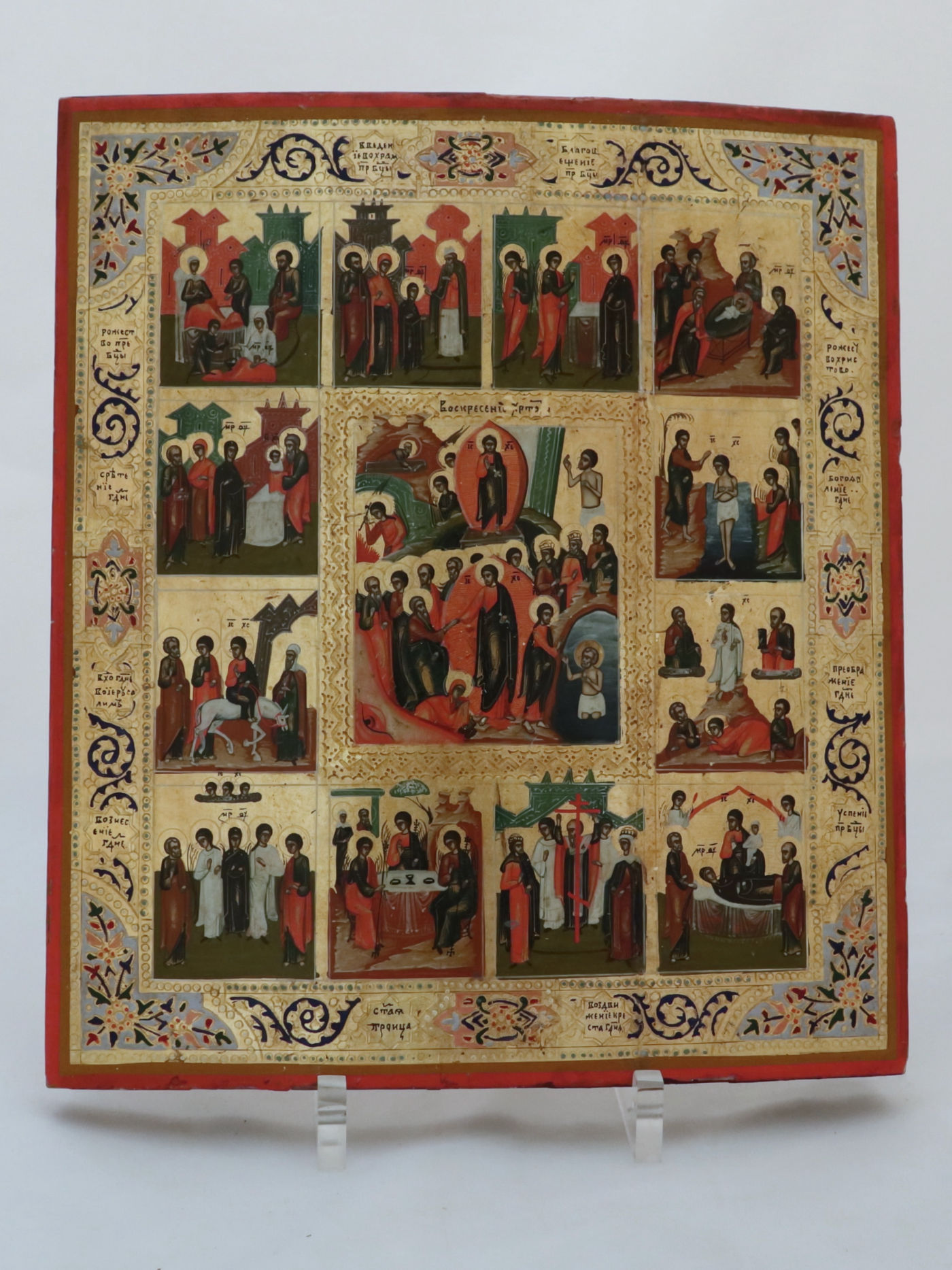
Russian icon of “Easter and the Twelve Great Feasts” from the Moscow School of the 19th century. At its center is the Resurrection of Christ and the Descent into Hades, surrounded by the twelve most important feasts of the Orthodox liturgical year.
Russian icon from the 19th century, 35.5 × 31.5 cm, Moscow School.
This remarkable Russian feast-day icon from the Moscow School of the nineteenth century brings together the most important events of salvation history within a single composition. At its center is the Resurrection of Christ in its traditional Orthodox form as the Descent into Hades. Christ stands upon the shattered gates of the underworld and raises Adam and Eve from the captivity of death. Around Him gather the righteous of the Old Testament who awaited redemption through the Messiah.
This image is one of the most profound expressions of Orthodox theology, symbolizing Christ’s victory over death, sin, and corruption. Surrounding the central Easter scene are the Twelve Great Feasts, which form the core of the Orthodox liturgical year. Each panel represents a decisive moment in salvation history and together they create a visual summary of the Christian faith. The depicted feasts are: 1. Nativity of the Mother of God (September 8) 2. Presentation of the Mother of God in the Temple (November 21) 3.
Annunciation to the Mother of God (March 25) 4. Nativity of Christ (December 25) 5. Presentation of Christ in the Temple (February 2) 6. Baptism of Christ in the Jordan – Theophany (January 6) 7. Entry into Jerusalem (Palm Sunday) 8. Transfiguration of Christ on Mount Tabor (August 6) 9. Ascension of Christ (40 days after Easter) 10. Holy Trinity – The Hospitality of Abraham (Pentecost) 11. Exaltation of the Holy Cross (September 14) 12.
Dormition of the Mother of God (August 15) The arrangement of these scenes transforms the icon into a visual compendium of salvation history, extending from the birth of the Virgin Mary to the Resurrection of Christ and the fulfillment of God’s plan for humanity. Such icons functioned not only as devotional objects but also as visual catechisms, allowing believers to contemplate the most important feasts of the Church within a single image. Particularly striking is the poliment-gilded background enriched with finely engraved and painted ornamentation.
The luminous gold surface unifies the many scenes and creates a radiant spiritual atmosphere. The careful execution of the numerous miniature compositions demonstrates a high level of artistic refinement and makes this icon an outstanding example of nineteenth-century Moscow icon painting.
Object identity
- Object title
- Easter and the 12 Great Feasts
- Inventory number
- 24598
- Origin or type
- Russian Icons
- Date
- 19th Century
- Dimensions
- 35.5 × 31.5 cm
- Painting school
- Malschule Moskau
- Canonical page
- https://ikonen-mautner.com/en/collection/ostern-und-die-12-hochfeste-24598
Learn about object identification and certificate verification