Icons of Saint Nicholas: A Collector's Guide to Antique Orthodox Icons of the Wonderworker
Saint Nicholas, bishop of Myra in Lycia in the 4th century, is one of the most popular saints in Orthodox icon painting. In Russia he is called Nikola the Wonderworker. He is shown as a bishop with a Gospel book and a blessing hand, and in several well-known types of his own. This guide explains the main types, how Greek and Russian icons of Saint Nicholas differ, and what to look for in an antique icon of Saint Nicholas.
Who Saint Nicholas is in Orthodox icons
Nicholas was bishop of Myra, a city in Lycia in present-day Türkiye, in the 4th century. Tradition remembers him as a worker of miracles and a protector of sailors, travellers and children. His feast falls on 6 December, which is 19 December in the civil calendar for churches that keep the Julian calendar. The Western Santa Claus grew out of the same figure, but the icon shows the bishop, not the gift-giver: a serious figure in a bishop's vestments.
The main types of Saint Nicholas icons
The standard type shows Nicholas as a bishop, in half-length or full-length, with a high forehead and short white hair and beard. He holds a Gospel book in his left hand and blesses with his right. In a well-known variant Christ appears in one upper corner holding out a Gospel, and the Mother of God in the other, holding the bishop's omophorion, the cloth worn on the shoulders. The scene refers to the tradition of his consecration as bishop. Nicholas of Mozhaisk is a Russian type. The saint holds a sword in one hand and a model of a city in the other, as protector of the town of Mozhaisk. Vita icons show Nicholas in the centre, surrounded by small scenes from his life, such as the rescue of three men condemned to death and the gift to three poor sisters. They are larger and more complex objects, and their completeness matters for value.
Greek and Russian models
Greek icons carry Greek inscriptions and follow Byzantine and post-Byzantine models: calm, symmetrical figures, often on a gold ground. Russian icons use Church Slavonic inscriptions, call the saint Nikola, and from the 17th century on often show more colour and ornament. Many Russian icons carry a silver or brass oklad that covers everything except face and hands.
How to date an antique icon of Saint Nicholas
No single feature proves age. The panel, the ground, the paint, the inscription and the wear have to agree with each other. Look for a wooden panel, often with a recessed centre called a kovcheg, and for natural craquelure in the ground. Most antique icons of Saint Nicholas on the market date from the 18th and 19th centuries. A written expert appraisal should confirm age and school.
What to check when buying
Type and inscription: the title should match the composition, in Greek or Church Slavonic. Face and hands: the most common places for later overpainting. Panel and ground: age and wear should agree with the claimed date. Oklad or frame: a silver oklad can carry a hallmark that helps with dating. Appraisal: ask for a written expert report with age, school and condition.
Available icons
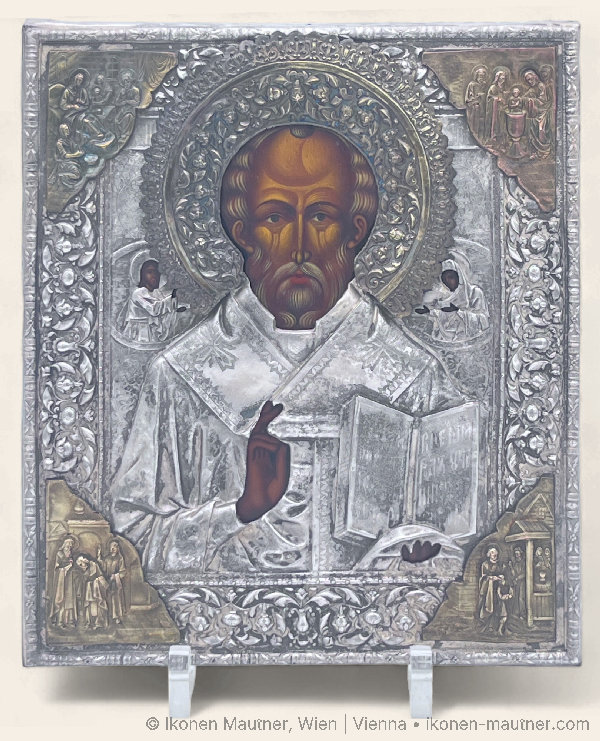
No. 25168
Saint Nicholas, Archbishop of Myra
Around 1900 / Modern
30.5 × 25.5 cm (H × W)
Price on request
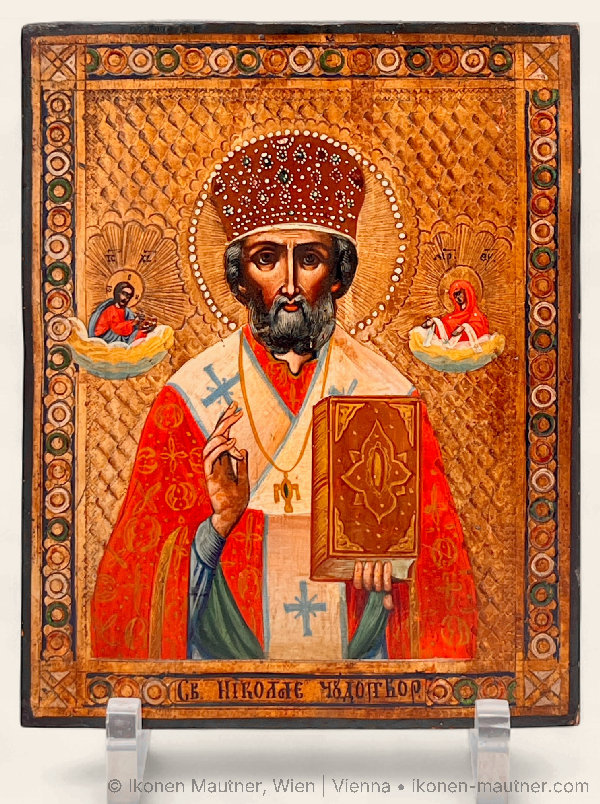
No. 25174
Saint Nicholas, Archbishop of Myra
19th Century
22 × 17.5 cm (H × W)
Price on request
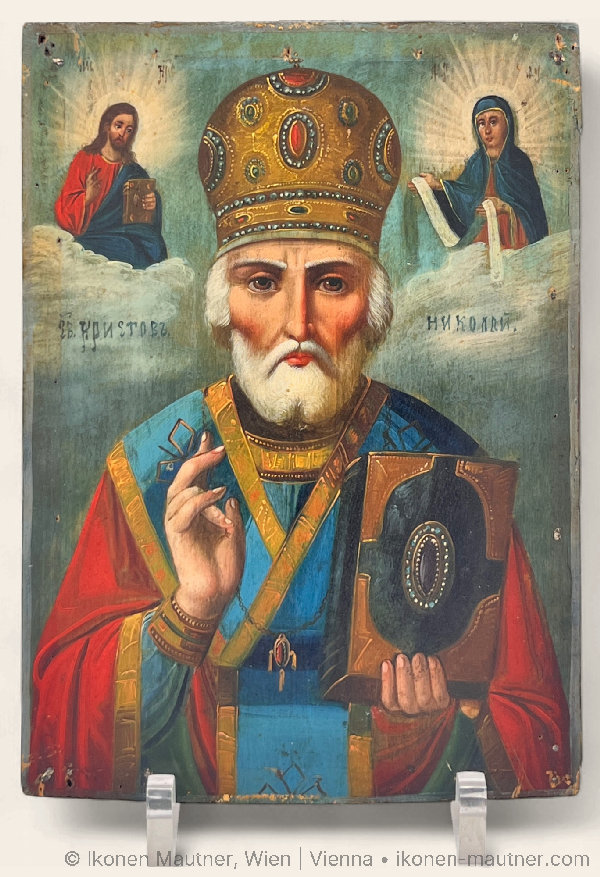
No. 25139
Saint Nicholas, Archbishop of Myra
19th Century
29 × 21 cm (H × W)
Price on request
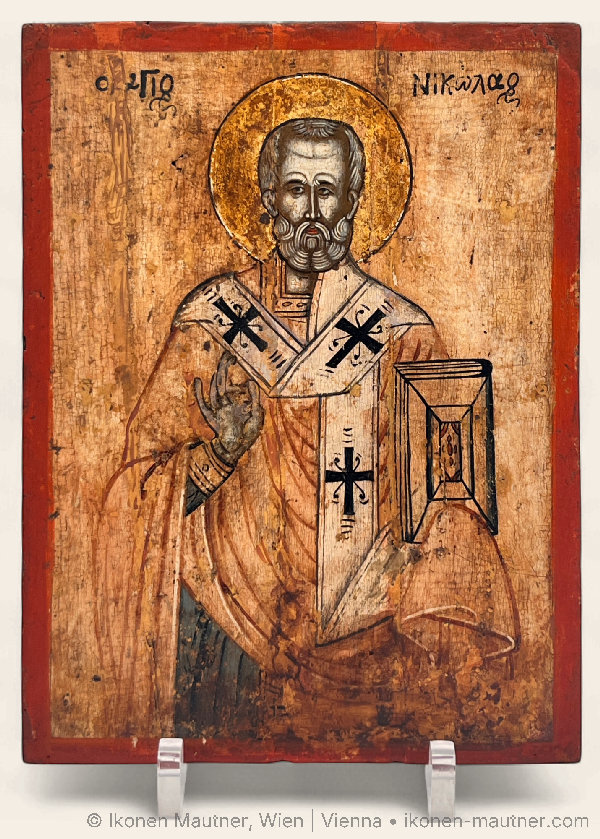
No. 25126
Saint Nicholas, Archbishop of Myra
18th Century
31.8 × 23.7 cm (H × W)
Price on request
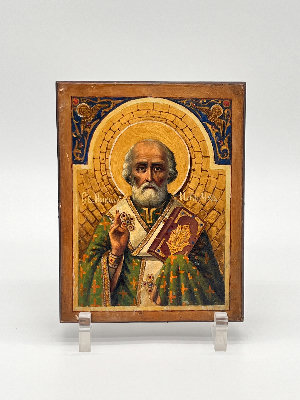
No. 25098
Saint Nicholas, Archbishop of Myra
Around 1900 / Modern
25 × 20.5 cm (H × W)
Price on request
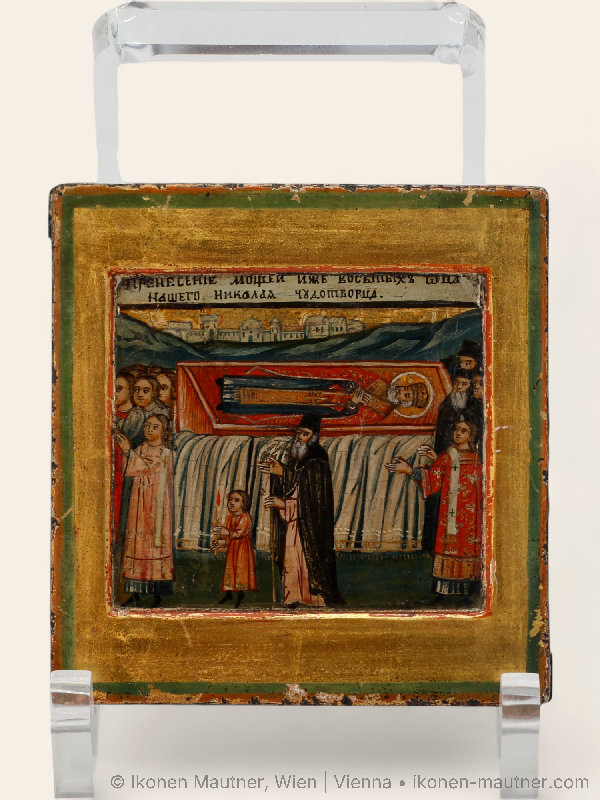
No. 24923
Translation of the relics of Saint Nicholas
18th Century
13 × 12.5 cm (H × W)
Price on request
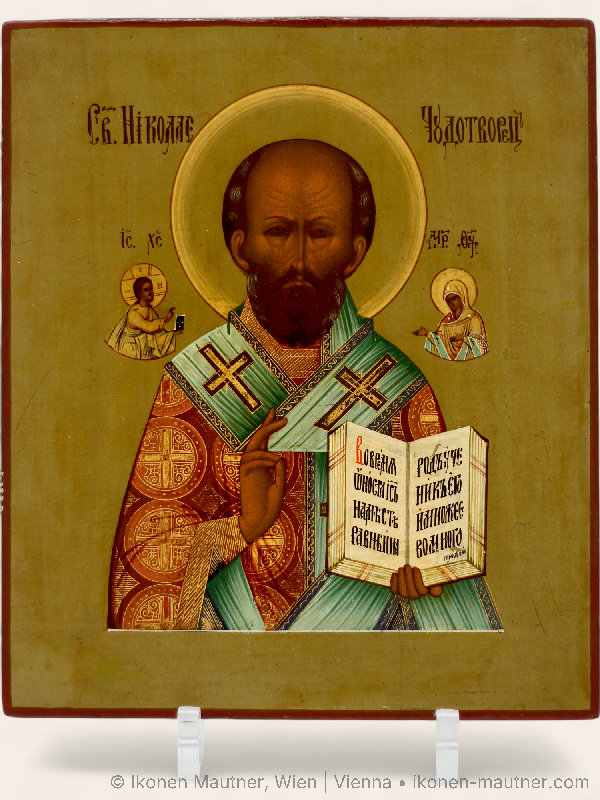
No. 24824
Saint Nicholas, Archbishop of Myra
19th Century
31 × 26.4 cm (H × W)
Price on request
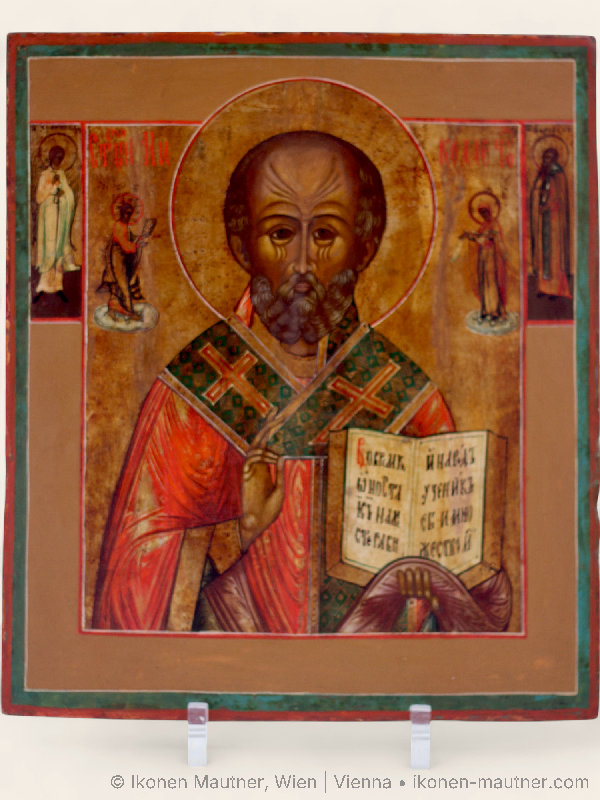
No. 24813
Saint Nicholas, Archbishop of Myra
19th Century
35 × 30.5 cm (H × W)
Price on request
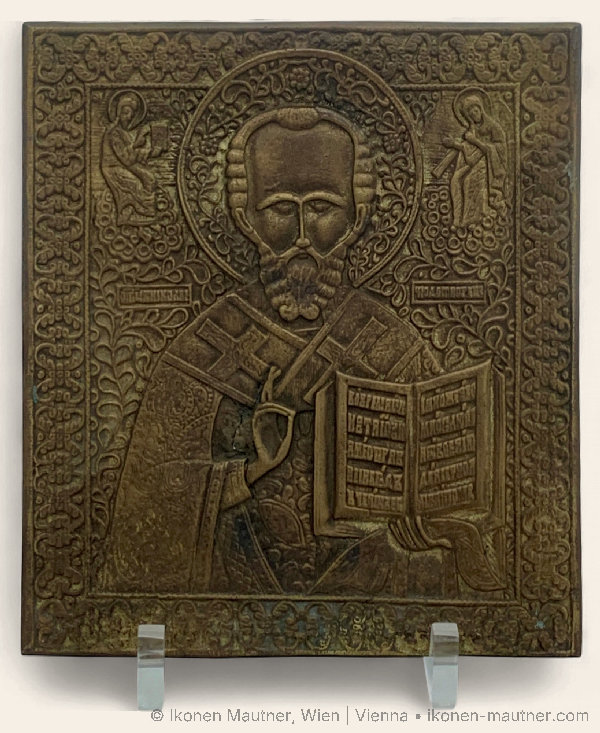
No. 24574
Saint Nicholas, Archbishop of Myra
Around 1900 / Modern
24.5 × 22 cm (H × W)
Price on request
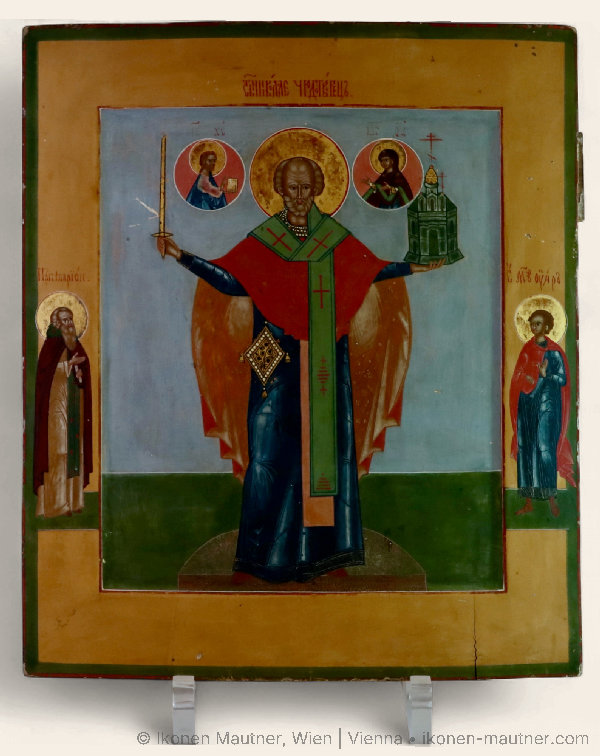
No. 20528
Saint Nicholas, Archbishop of Myra
Around 1800
31 × 27 cm (H × W)
Price on request
Frequently Asked Questions
Why is Saint Nicholas shown with a book and a blessing hand?
The Gospel book marks him as a bishop and teacher, and the right hand gives the blessing used by bishops. Both are fixed parts of the standard type.
What is the difference between Saint Nicholas and Santa Claus?
Santa Claus is a later Western figure that grew out of the memory of Saint Nicholas, whose feast is on 6 December. The icon shows the historical bishop of Myra in vestments, not a gift-giver in a red coat.
How do I tell a Russian from a Greek icon of Saint Nicholas?
Check the inscription first: Greek icons use Greek letters, Russian icons use Church Slavonic. Then look at the style. Greek icons are usually calmer and more strictly Byzantine, Russian ones often carry more colour and ornament.
Can I import an antique icon into the United States?
Yes. No import duties apply, and a small duty processing fee may occur. Shipping costs $100 to $250 depending on the icon and includes free insurance.
Authenticity and buying from the US
Every icon from Ikonen Mautner comes with an Expertise, a written appraisal with a QR code that links to the record of the piece. Ikonen Mautner has traded in antique Orthodox icons in Vienna since 1959. Shipping to the United States costs between $100 and $250, depending on the icon. Every piece ships fully insured, and the insurance is free of charge.
No import duties apply. A small duty processing fee may occur.
Related guides
- Icons of the Mother of God: A Collector's Guide to Antique Orthodox Icons of Mary
- The Resurrection in Orthodox Icons: The Harrowing of Hades and How to Recognise It
- Icons of St John the Baptist: A Collector's Guide to the Forerunner in Orthodox Icons
- Icons of Christ Pantocrator: A Collector's Guide to Antique Orthodox Icons of Christ
- Icons of Archangel Michael: A Collector's Guide to Antique Orthodox Icons of the Archistrategos
- Saint Nicholas in Orthodox iconography: meaning, symbols and regional variations